Leading Across Cultures
About this lesson: This is a C1 (Advanced) ESL lesson in the Business English category. It takes about 60 minutes. It includes 5 vocabulary words, 3 idioms and phrasal verbs, a reading text, comprehension questions, discussion questions and speaking patterns. Suits one-to-one or small-group online classes. Free to open and teach with no login, and it prints as a PDF.
Print just the discussion questions
How this lesson is built
This is a complete conversation lesson built on a scientific pedagogical formula, not a generic worksheet: recall prior topic vocabulary, pre-teach the new words in depth, read in context, practise active recall with flashcards and synonyms/antonyms, build accuracy with exercises, and finish with deep discussion.
- Warm-up: Discussion questions that connect the topic to the student’s own life and recall vocabulary they already know about the subject.
- Reading: A text written for this CEFR level that uses each new word two or three times in context, giving the student something meaningful to react to.
- Key vocabulary: 5 new words, pre-taught before the reading with a definition, pronunciation guide, example sentences and a picture, plus word families, usage notes, recall flashcards and synonyms/antonyms, giving a solid grounding before reading.
- Comprehension: 5 questions that check the new words: retrieval practice, not rereading.
- Idioms and phrasal verbs: Expressions taken from the reading, each with its meaning, an example and a speaking question.
- Sentence frames: 3 speaking patterns, each at three levels of support (emerging, developing, expanding) with model answers—especially helpful scaffolding for beginners and less confident speakers.
- Gap-fill: The new words again, in a shuffled order, so the student recalls them by meaning in context.
- Sentence unscramble: Natural sentences with the new words to put back in order, reinforcing grammar and collocation.
- Discussion: 5 open questions designed to talk deeply about the subject while actively using the lesson’s target vocabulary: the heart of a conversation lesson.
- Quiz: A short retrieval check that brings every new word back once more.
Unlike a generic worksheet, the new words are taught before the reading and met again in the activities, the speaking is supported at three levels and most of the time goes on the student talking. Teachers who use PlanWise ESL also get per-student vocabulary tracking (recycling earlier words into future readings and questions), a private learner dashboard with flashcards and custom lesson creation, and a downloadable study PDF.
Warm-up Activity
Look at the questions and talk about your own experience of working or dealing with people from other cultures.
- Have you ever worked with someone from a very different culture? What surprised you?
- Do you think there's such a thing as a 'national personality'? Or is that just stereotyping?
- When you meet someone new, how do you usually figure out what kind of person they are?
- Have you ever accidentally offended someone without meaning to? What happened?
- If your boss moved your team to another country, what do you think would be the hardest thing to get used to?
Reading Text: When the Boss Speaks Last
A short article about how leadership styles clash across cultures — and why the 'right' way to manage in one country can fail badly in another.
When a Dutch manager took over a team in Japan, she did everything by the book: open-door policy, first-name terms, ideas welcome from anyone, anytime. Within a month, her team seemed distant and quiet. The problem wasn't laziness or resentment — it was that she had misread the room completely. Her team expected a leader to stand slightly apart, and her easy familiarity made them uneasy rather than inspired.
Management researchers have a name for this gap: the clash of expectations. In some workplaces, staff are openly deferential — they show respect by listening more than they speak and by never contradicting the boss in public. In others, that same behaviour reads as a worrying lack of initiative. Neither style is wrong; each is simply the local grammar of respect, and problems start when you assume your grammar is universal.
Then there's the question of how direct to be. A blunt 'this report isn't good enough' can feel refreshingly honest in Rotterdam and brutally rude in Bangkok, where criticism is often wrapped in several layers of politeness. Skilled managers learn to soften the message without losing it — a skill that looks like evasiveness to outsiders but is actually a form of diplomacy.
Building rapport across these differences takes deliberate effort. Small talk about family, shared meals, remembering a colleague's child's name — none of it appears on a job description, yet it's often what decides whether a team trusts its leader. In relationship-first cultures, skipping this stage isn't efficient; it's fatal.
Perhaps the deepest divide, though, is hierarchy itself. In flat organisations, the intern can email the CEO; in steep ones, skipping layers is a career-ending move. The wisest cross-cultural leaders don't pick a side. They ask, watch and adapt — holding on to their own values while speaking in a language of respect their team actually understands.
Key Vocabulary
deferential

showing respect and willingness to obey or accept someone's opinion
He stayed deferential in the meeting, never questioning the director's plan.
More examples: The new interns were almost comically deferential around senior partners. • She's polite but not deferential — she'll push back if she disagrees. • I felt oddly deferential the first time I met my hero.
Common collocations: deferential attitude, be deferential towards/to someone, treat someone with deference
Word family: deference (noun), defer (verb), deferentially (adverb)
Synonyms: respectful, submissive, obsequious
Antonyms: assertive, insubordinate
Related concepts: hierarchy, etiquette, authority
Contexts: the workplace, formal ceremonies, family traditions
Usage note: Usually describes behaviour towards authority or seniority. Often slightly formal; can hint that the respect is excessive.
rapport

a friendly, trusting relationship where people understand each other well
She built a real rapport with the team by having coffee with each of them.
More examples: There was instant rapport between the two negotiators. • Good teachers establish rapport with students in the first five minutes. • I never managed to build much rapport with my old boss.
Common collocations: build/establish rapport, have a good rapport with someone, instant rapport
Word family: (no common related forms)
Synonyms: connection, chemistry, understanding
Antonyms: friction, estrangement
Related concepts: trust, teamwork, networking
Contexts: negotiations, teaching, client relationships
Usage note: Almost always positive. Common with verbs build, establish, strike up. The 't' is silent.
blunt

speaking very directly, even when it might upset someone
To be blunt, your proposal needs another six months of work.
More examples: She's blunt to the point of rudeness sometimes. • I appreciate his blunt feedback — at least you know where you stand. • The review was blunt but fair.
Common collocations: to be blunt, blunt honesty, blunt criticism
Word family: bluntly (adverb), bluntness (noun)
Synonyms: frank, direct, candid
Antonyms: tactful, evasive
Related concepts: feedback, honesty, diplomacy
Contexts: performance reviews, negotiations, friendship
Usage note: Describes speech or feedback. 'To be blunt' is a common softener before a harsh statement. Neutral to slightly negative depending on tone.
hierarchy
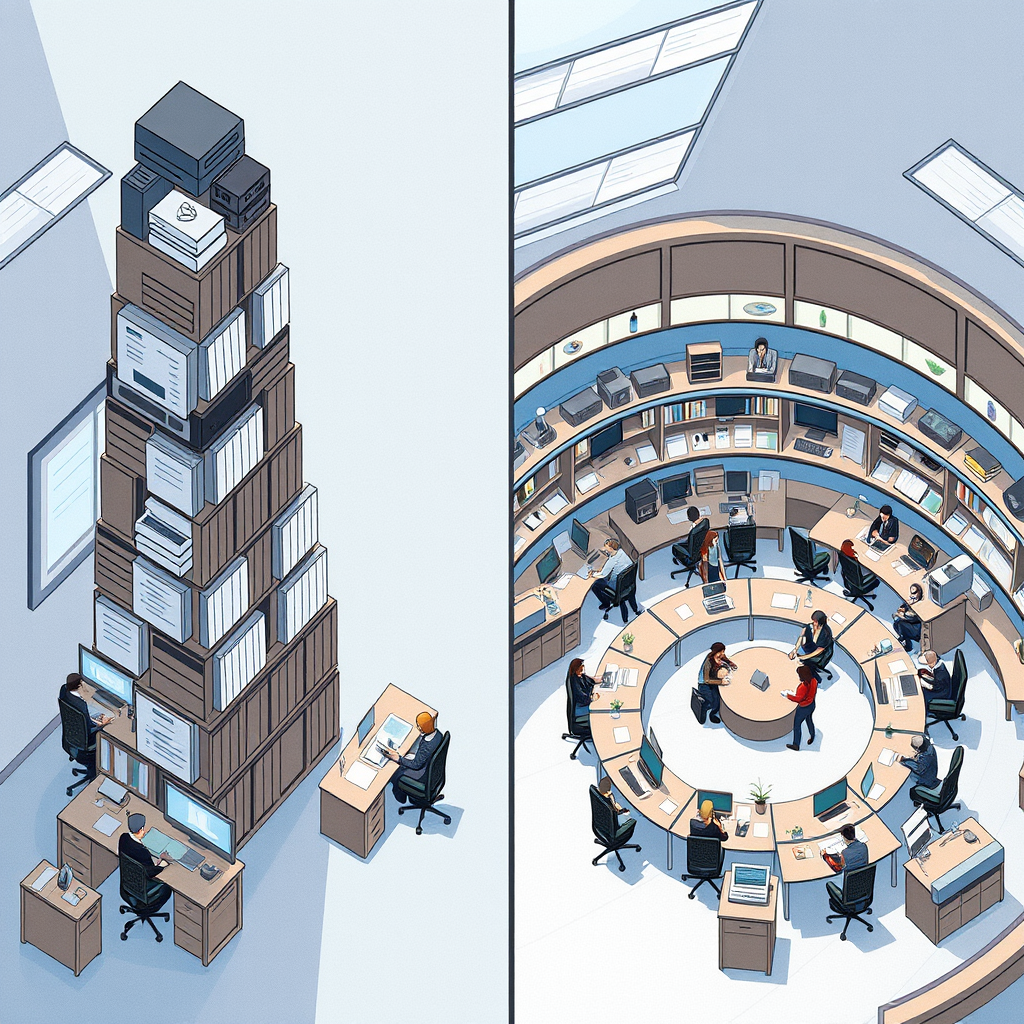
a system that ranks people, with some above others in power
In that company, the hierarchy is so steep that interns never meet directors.
More examples: She climbed the corporate hierarchy faster than anyone expected. • The flat hierarchy means anyone can challenge the CEO's idea. • Age still matters in the workplace hierarchy here.
Common collocations: a steep/flat hierarchy, climb the hierarchy, the top of the hierarchy
Word family: hierarchical (adjective), hierarchically (adverb)
Synonyms: pecking order, chain of command, ranking
Antonyms: egalitarianism, flat structure
Related concepts: authority, seniority, power distance
Contexts: corporations, government, the military
Usage note: Used for companies, societies, even animals. 'Steep' hierarchy means many levels and big power gaps; 'flat' means few.
read the room

to notice the mood of people present and adjust your behaviour
Nobody was laughing at his jokes — he really should have read the room.
More examples: She read the room and dropped the salary topic when the mood soured. • Learn to read the room before you start pitching your wild ideas. • He completely failed to read the room and kept pushing his agenda.
Common collocations: fail to read the room, quick to read the room, read the room and adapt
Word family: (informal related phrase: read someone)
Synonyms: take the temperature, size up the situation, pick up on the mood
Antonyms: misjudge the mood, put your foot in it
Related concepts: emotional intelligence, social skills, tact
Contexts: meetings, presentations, parties
Usage note: Informal but very common in workplaces and politics. Often used critically when someone gets the mood wrong.
Vocabulary Check
- What does 'deferential' mean?
- Speaking very directly
- Showing respect and accepting someone's authority
- Feeling nervous in new situations
- Being friendly and talkative
- Which sentence uses 'rapport' correctly?
- She gave me some blunt rapport about my essay.
- The rapport of the company is very steep.
- He built a good rapport with the new clients.
- We need to rapport the meeting until Friday.
- In which situation would you use 'blunt'?
- When you want to soften bad news
- When you tell someone the harsh truth directly
- When you make small talk at a party
- When you follow your boss's instructions
- What is a 'hierarchy'?
- A friendly working relationship
- A ranking system with some people above others
- A style of direct communication
- A meeting to share ideas
- If someone 'reads the room', what are they doing?
- Preparing a presentation
- Checking the meeting agenda
- Noticing the group's mood and adjusting to it
- Reading documents before a discussion
Idioms & Phrasal Verbs
go along with
Accept or support a plan or decision, even if you're not keen on it
I didn't love the idea, but I went along with it to keep the peace.
Usage note: Separable? No — the object always comes after 'with': go along with it, not 'go it along with'. · Right: went along with the plan · Avoid: went the plan along with
Usage note: Often suggests passive agreement — you follow the group rather than actively choose.
by the book
Follow the rules exactly, strictly and correctly
Our HR department does everything by the book — every decision needs three signatures.
Usage note: The 'book' is the official rulebook. Sometimes it suggests someone is a bit inflexible.
Usage note: Used in neutral and slightly critical ways, depending on tone.
pick a side
Choose to support one person, group or opinion in a disagreement
My parents argue about where to spend Christmas, and I refuse to pick a side.
Usage note: Picture a fight where you walk over and stand on one team's side of the line.
Usage note: Common in both personal and political talk; 'refuse to pick a side' is a very natural phrase.
Language Practice: Talking About Leadership Styles
Practice expressing and qualifying opinions about leadership and cultural differences.
- Conceding a point before disagreeing
- Emerging: I see the point about ___, but ___. — I see the point about efficiency, but relationships matter more in some cultures.
- Developing: It's true that ___, yet at the same time ___. — It's true that flat hierarchies encourage ideas, yet at the same time they can confuse people used to clear orders.
- Expanding: While I'd accept that ___, that doesn't change the fact that ___. — While I'd accept that deference keeps things orderly, that doesn't change the fact that silent teams hide serious problems.
- Qualifying an opinion about culture
- Emerging: In my experience, ___ tends to ___. — In my experience, managers here tend to avoid saying no directly.
- Developing: It's not so much ___ as ___. — It's not so much rudeness as a different idea of politeness.
- Expanding: What strikes me most about ___ is how ___, especially when ___. — What strikes me most about cross-cultural teams is how quickly misunderstandings escalate, especially when nobody asks questions.
- Hypothesising about cross-cultural situations
- Emerging: If a manager did that here, people would ___. — If a manager did that here, people would just go quiet.
- Developing: I imagine ___ would go down badly/well here, because ___. — I imagine public criticism would go down badly here, because face matters so much.
- Expanding: Were a leader to ignore that, the most likely result would be ___, if not ___. — Were a leader to ignore that, the most likely result would be silent resentment, if not outright resignations.
Fill in the Blanks
When Marta arrived to lead the São Paulo office, she quickly realised she had to _____ before changing anything. Her predecessor had been famously _____, and although the New York head office admired his honesty, the local team had found it humiliating. Marta spent her first weeks building _____ — long lunches, endless questions, genuine curiosity. She noticed how _____ the junior staff were around senior colleagues, and how carefully everyone respected the company's steep _____. Only then did she start making changes, and by then, the team was ready to hear them.
Word bank: deferential, rapport, blunt, hierarchy, read the room
Sentence Unscramble
- Good / leaders / read / the / room / before / they / speak.
- She / was / blunt / but / never / unkind / in / her / feedback.
- Building / rapport / across / cultures / takes / patience / and / genuine / curiosity.
Discussion Questions
Imagine a manager from a very direct culture — say, the Netherlands or Germany — takes over a team in a country where criticism is always given privately and gently. Within weeks, the team seems unhappy, though nobody says anything. The manager is baffled.
What do you think is actually going wrong here, and what's the first thing the manager should do? Have you ever seen a mismatch like this?
Some companies pride themselves on flat hierarchies — no titles, everyone calls the CEO by their first name, ideas can come from anywhere. Others keep clear chains of command, where challenging your boss is close to career suicide. Both systems produce successful companies.
Which system would you personally work best in, and why? What would happen if the two types merged after a big company takeover?
There's a saying that 'when in Rome, do as the Romans do' — adapt fully to local customs. But some leaders argue you can adapt so much that you lose yourself, or quietly accept things you believe are wrong, like excluding women from meetings or tolerating open favouritism.
Where would you draw the line between adapting to a culture and betraying your own values? Can you think of a practice you'd refuse to go along with?
Small talk seems trivial — chatting about football, family or the weather. Yet in many cultures, no real business happens until that relationship is built, and skipping it can sink a deal that took months to arrange.
Do you enjoy small talk, or does it feel like a waste of time? Has a casual conversation ever led somewhere unexpected for you?
Suppose you were asked to lead a team scattered across five countries — Japan, Brazil, Sweden, Nigeria and the US. Each group has different expectations about hierarchy, directness and how much a boss should socialise with staff. You can't be five different people at once.
How would you try to lead all of them without becoming a different person in every meeting? Which difference do you think would be hardest for you to handle?
Knowledge Check
- Which word describes someone who accepts a senior person's judgement without questioning it?
- Blunt
- Deferential
- Flat
- Rapport
- True or false: 'rapport' is pronounced with a silent final 't'.
- True
- False
- If you 'read the room', you are...
- checking the schedule
- sensing the group's mood and adapting
- reading documents aloud
- preparing slides
- A 'steep hierarchy' means...
- very few levels and equal power
- many levels with large gaps in power
- a company that is failing
- a very tall office building
- True or false: calling someone 'blunt' always means they are being rude.
- True
- False
- If a manager 'can't read the room', what is the problem?
- They are bad at following the official rules
- They don't notice how the people around them are feeling
- They can't understand written documents
- They don't know the layout of the office
Free to use with your students: Free to teach, screen-share, print and share with your students, with a credit to PlanWise ESL. Please do not sell it or republish it as your own. What you can do with free lessons.