Calendars, Ritual, and Renewal: What Global New Year Traditions Reveal About Culture
About this lesson: This is a C2 (Proficiency) ESL lesson in the Conversation Practice category. It takes about 60 minutes. It includes 5 vocabulary words, 4 idioms and phrasal verbs, a reading text, comprehension questions, discussion questions and speaking patterns. Suits one-to-one or small-group online classes. Free to open and teach with no login, and it prints as a PDF.
Print just the discussion questions
How this lesson is built
This is a complete conversation lesson built on a scientific pedagogical formula, not a generic worksheet: recall prior topic vocabulary, pre-teach the new words in depth, read in context, practise active recall with flashcards and synonyms/antonyms, build accuracy with exercises, and finish with deep discussion.
- Warm-up: Discussion questions that connect the topic to the student’s own life and recall vocabulary they already know about the subject.
- Reading: A text written for this CEFR level that uses each new word two or three times in context, giving the student something meaningful to react to.
- Key vocabulary: 5 new words, pre-taught before the reading with a definition, pronunciation guide, example sentences and a picture, plus word families, usage notes, recall flashcards and synonyms/antonyms, giving a solid grounding before reading.
- Comprehension: 5 questions that check the new words: retrieval practice, not rereading.
- Idioms and phrasal verbs: Expressions taken from the reading, each with its meaning, an example and a speaking question.
- Sentence frames: 3 speaking patterns, each at three levels of support (emerging, developing, expanding) with model answers—especially helpful scaffolding for beginners and less confident speakers.
- Gap-fill: The new words again, in a shuffled order, so the student recalls them by meaning in context.
- Sentence unscramble: Natural sentences with the new words to put back in order, reinforcing grammar and collocation.
- Discussion: 5 open questions designed to talk deeply about the subject while actively using the lesson’s target vocabulary: the heart of a conversation lesson.
- Quiz: A short retrieval check that brings every new word back once more.
Unlike a generic worksheet, the new words are taught before the reading and met again in the activities, the speaking is supported at three levels and most of the time goes on the student talking. Teachers who use PlanWise ESL also get per-student vocabulary tracking (recycling earlier words into future readings and questions), a private learner dashboard with flashcards and custom lesson creation, and a downloadable study PDF.
Warm-up: Midnight Around the World
Look at the images of New Year celebrations from different countries and talk about your own experience of the turn of the year.
- How do you usually spend New Year's Eve — and has that changed over the years?
- What's the most memorable New Year you've ever had? What made it stick in your mind?
- Is there a tradition in your country that outsiders would find strange if you described it?
- Do you actually like New Year's Eve, or do you think it's a slightly overrated night?
- When do you feel the year has really 'started' — midnight on the 31st, or some other moment?
Reading Text: Twelve Grapes and 108 Bells
A short piece on how different cultures cross the midnight line — and what those choices say about them.
Every thirty-first of December, humanity stages the same peculiar performance: millions stay up past midnight to watch a number change — for children everywhere, a small rite of passage. And yet the revelry in Madrid bears no resemblance to the hush of a Tokyo temple. How a culture chooses to usher in the year reveals, perhaps more than any other festival, what it fears and what it hopes.
Consider Spain, where the stroke of midnight becomes a race against the clock: twelve grapes, one per chime, swallowed in twelve seconds. Tradition insists the grapes ward off a year of bad luck — miss one, and you've forfeited a lucky month. For Spanish children, mastering the grapes is a genuine rite of passage: the first time you manage all twelve, you've been admitted to the adult world of superstition, whether or not you believe a word of it.
Japan takes the opposite route. As the old year dies, temple bells ring 108 times, one toll for each human failing, and the streets fall almost silent. No fireworks, no revelry — just a slow, deliberate cleansing before the new year is ushered in. The contrast is telling: one culture shouts its way into January; the other listens.
Elsewhere the logic is blunter. Danes hurl old plates against their friends' doors, Latin Americans choose their underwear colour to court an auspicious year, and everywhere people perform small rituals to ward off misfortune — eating lentils for wealth, jumping off a chair at midnight, burning effigies of the old year.
Perhaps that's the real story. Whatever the costume, every one of these traditions is a negotiation with time itself — a collective promise that the year ahead can be made auspicious, if only we get the ritual exactly right.
Key Vocabulary
usher in
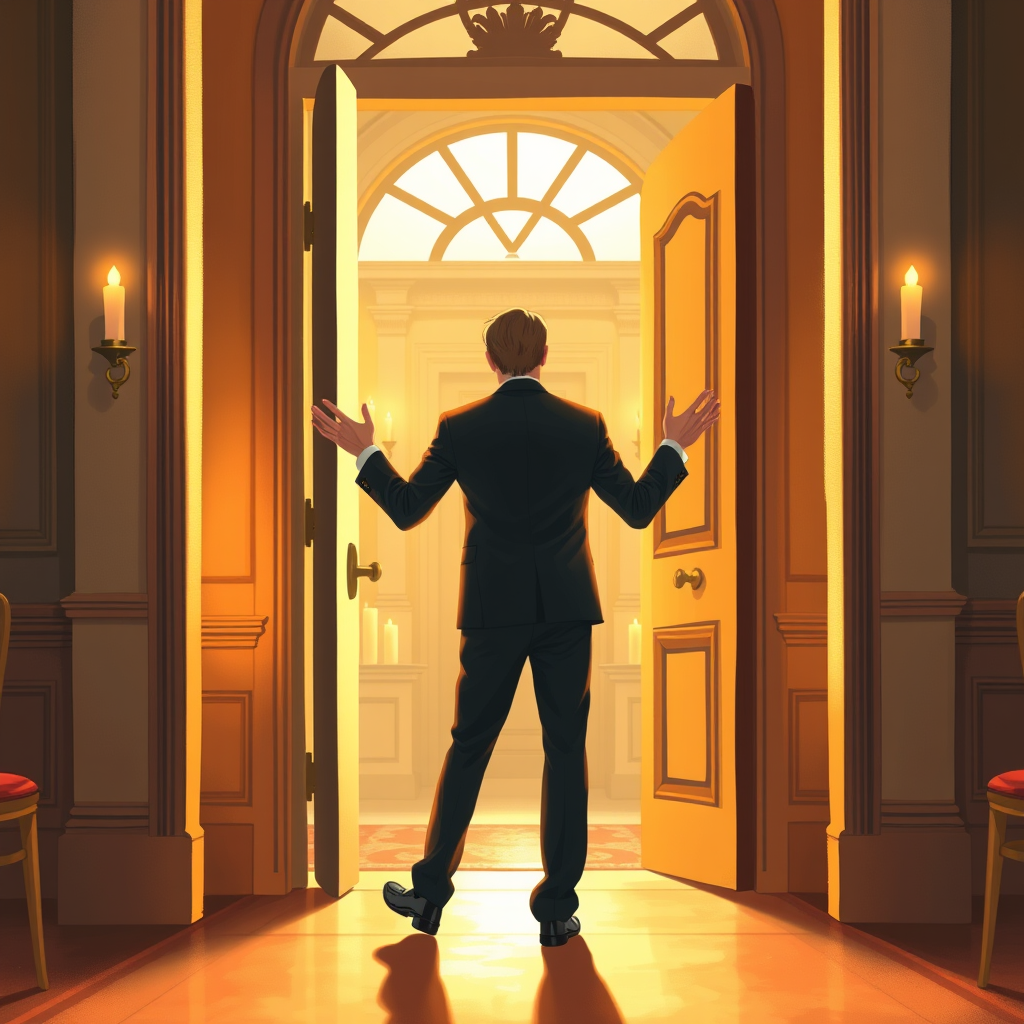
To mark or introduce the beginning of something new, often with ceremony or noticeable change.
The fireworks ushered in the new year with a deafening roar.
More examples: The fall of the wall ushered in a decade of enormous change. • A new manager usually ushers in a fresh round of office politics. • I like a quiet walk on the first of January to usher in the year properly.
Common collocations: usher in a new era, usher in the new year, usher in sweeping changes
Word family: usher (noun), ushering (noun)
Synonyms: herald, inaugurate, mark the start of
Antonyms: bring to a close, wind up, see out
Related concepts: new era, ceremony, transition
Contexts: politics and history, festivals and holidays, business change
Usage note: Slightly elevated register; the object is almost always an abstract beginning — an era, a period, a change, a year. You don't 'usher in' a pizza.
auspicious

Seeming to promise success or good fortune in the future; a favourable sign.
Starting the year with a flat tyre is hardly an auspicious sign.
More examples: The deal got off to an auspicious start with an hour of small talk over excellent coffee. • Choosing a wedding date is serious business — every aunt has an opinion on which one is auspicious. • It was an auspicious moment for the team: their first match in a new stadium, and they won.
Common collocations: an auspicious start, an auspicious occasion, an auspicious moment
Word family: auspiciously (adverb), inauspicious (adjective), auspice (noun, rare)
Synonyms: promising, favourable, propitious
Antonyms: inauspicious, unpromising, ill-fated
Related concepts: omen, luck, fortune-telling
Contexts: weddings and ceremonies, business launches, superstition
Usage note: Slightly formal but very common in speech among educated speakers. Often used with irony or understatement: 'hardly auspicious', 'not the most auspicious beginning'.
ward off

To try to keep something unpleasant away from you, or prevent it from affecting you.
She wore red on New Year's Eve to ward off bad luck.
More examples: A hot lemon and honey is my mother's answer to warding off every winter cold. • He cracked his knuckles and glared, trying to ward off the interviewer's next question. • Villagers hung the herbs by the door to ward off evil spirits.
Common collocations: ward off evil spirits, ward off a cold, ward off danger
Word family: ward (noun), bodyguard (noun)
Synonyms: fend off, keep at bay, stave off
Antonyms: invite, attract, welcome
Related concepts: amulets, superstition, immunity
Contexts: folk traditions, health and illness, personal safety
Usage note: The thing warded off is usually a threat, illness, bad luck or an unwanted approach. Works for both physical defence and symbolic or superstitious protection.
revelry

Lively, noisy celebrating and partying, often lasting late into the night.
The revelry in the streets continued until well after sunrise.
More examples: After the final whistle, the city dissolved into pure revelry. • From the next apartment came sounds of revelry that made sleep impossible. • The office Christmas party descended from polite drinks into full-blown revelry by ten.
Common collocations: late-night revelry, drunken revelry, the revelry died down
Word family: revel (verb), reveler (noun)
Synonyms: merrymaking, carousing, festivities
Antonyms: solemnity, quiet, sobriety
Related concepts: carnival, festival, nightlife
Contexts: New Year celebrations, festivals, weddings
Usage note: Slightly literary but alive in journalism and everyday storytelling. Often carries a hint of excess — revelry is fun, but it's the kind of fun that leaves a mess.
rite of passage

An event or experience that marks a major transition from one stage of life to another.
Surviving your first job interview is a rite of passage for most graduates.
More examples: For teenagers everywhere, learning to drive is a rite of passage. • Getting spectacularly lost on your first solo trip abroad has become a rite of passage for backpackers. • In some cultures, a rite of passage into adulthood involves weeks of preparation and a public ceremony.
Common collocations: a rite of passage for, a classic rite of passage, mark a rite of passage
Word family: rite (noun), ritual (noun, adjective)
Synonyms: milestone, initiation, coming-of-age ceremony
Antonyms: ordinary event, routine, everyday occurrence
Related concepts: adulthood, initiation ceremonies, tradition
Contexts: anthropology, family life, school and work milestones
Usage note: Frequently used figuratively for any shared milestone, often with a smile: embarrassing first jobs, terrible student flats, first all-nighters. The plural is 'rites of passage'.
Vocabulary Check
- Which sentence uses 'usher in' correctly?
- She ushered in her coffee before the meeting started.
- He ushered in the door and sat down quickly.
- The peace agreement ushered in a new era for the region.
- They ushered in the bill because it was too expensive.
- What does 'auspicious' mean?
- Seeming to promise success or good luck
- Deliberately rude or disrespectful
- Extremely expensive and luxurious
- Old-fashioned and out of date
- In which situation would you most naturally 'ward off' something?
- You want to invite your friends to a party.
- You want to celebrate a promotion with champagne.
- You want to remember someone's birthday.
- You feel a cold coming on and drink ginger tea to stop it.
- What does 'revelry' mean?
- A formal religious ceremony
- Lively, noisy celebrating, often late into the night
- A quiet feeling of satisfaction
- A serious discussion about important matters
- Which of these is the best example of a rite of passage?
- Brushing your teeth every morning
- Buying a lottery ticket on a whim
- Getting your first set of house keys and moving out of your parents' home
- Choosing what to have for lunch
Idioms & Phrasal Verbs
bear no resemblance to
to be completely different from something, not at all alike
The quiet dinner we planned bore no resemblance to the wild party that actually happened.
Usage note: A set phrase for strong contrast — stronger than just saying 'very different'. Common in both speech and writing.
Usage note: Use 'bears' with he/she/it, and keep 'no': it's 'bears no resemblance', not 'doesn't bear resemblance'.
the stroke of midnight
the exact moment it becomes midnight
Everyone raised their glasses at the stroke of midnight and hugged whoever was nearest.
Usage note: The 'stroke' is the sound of the clock striking — the word is old but the phrase is still standard. We say 'at the stroke of midnight', not 'in' or 'on'.
Usage note: Also used figuratively: 'at the stroke of a pen' means instantly, by one official decision.
ring in
to welcome or celebrate the start of something, usually the new year
We rang in the new year at a friend's rooftop with champagne and terrible karaoke.
Usage note: Always with the thing being welcomed as the object: 'ring in the new year'. You can also say 'the bells rang in the new year'.
Usage note: Don't confuse it with 'ring up' (phone someone) or 'ring off' (end a call).
make it stick
to make sure a change or idea lasts and doesn't fade away
The gym was packed in January; by March, only a few had made the habit stick.
Usage note: The picture is glue: something that sticks stays where you put it. Also used for rules, advice and punishments.
Usage note: Often used as 'make the change stick' or 'make the habit stick' — you name what sticks.
Language Practice: Talking About Ritual and Renewal
Practice conceding, speculating and persuading while discussing traditions and fresh starts.
- Conceding a point before disagreeing with it
- Emerging: Admittedly, ___, but ___. — Admittedly, fireworks are beautiful, but they terrify every dog in the neighbourhood.
- Developing: I take your point about ___, but that said, ___. — I take your point about tradition bringing families together, but that said, it can also trap people in obligations they resent.
- Expanding: Granted, ___ — and I wouldn't go so far as to say ___, but ___. — Granted, the revelry is good for the economy — and I wouldn't go so far as to say we should ban it — but the pressure to have a perfect night makes a lot of people miserable.
- Speculating about the hidden meaning of customs
- Emerging: Maybe it's really about ___. — Maybe it's really about giving people a fresh start.
- Developing: My hunch is that ___ — presumably because ___. — My hunch is that the twelve grapes caught on — presumably because it turned a solemn moment into a game children could win.
- Expanding: I'd hazard a guess that ___; what's really going on, I suspect, is ___. — I'd hazard a guess that the Japanese prefer silence at midnight; what's really going on, I suspect, is a culture that treats endings as seriously as beginnings.
- Persuading someone to see a tradition differently
- Emerging: If you ask me, ___. — If you ask me, the best New Year tradition is the quiet one.
- Developing: What strikes me about ___ is that ___. — What strikes me about the grape race is that it turns luck into a skill you can practise.
- Expanding: What strikes me about ___ is that ___ — and isn't it telling that ___? — What strikes me about New Year customs is that they're all negotiations with time — and isn't it telling that no culture simply lets the year arrive without ceremony?
Fill in the Blanks
January arrives with a curious mixture of hangover and hope. After a week of _____ — the parties, the fireworks, the neighbours singing badly at three in the morning — most of us wake up on the first feeling oddly solemn. There's something quietly _____ about a blank calendar: 365 days, none of them ruined yet. Some people mark the date with a small personal _____, deleting an old habit or signing up for a gym they'll visit exactly twice. Others prefer to _____ the January blues with comfort food and early nights. Either way, we all seem to want the same thing: to _____ the year feeling like a slightly better version of ourselves — and to forgive ourselves, by the fifteenth, when we turn out not to be.
Word bank: usher in, auspicious, ward off, revelry, rite of passage
Sentence Unscramble
- the / bells / ushered / in / the / new / year / at / exactly / midnight
- she / wore / red / to / ward / off / bad / luck / all / year
- the / revelry / downtown / continued / long / after / the / fireworks / had / ended
Discussion Questions
In Spain, children race to swallow twelve grapes at midnight; in Japan, temples ring 108 bells into total silence; in Denmark, people smash plates on their friends' doorsteps. Each custom sounds completely normal to the people doing it and completely bizarre to everyone else. Somewhere in that gap between 'normal' and 'bizarre' is where culture actually lives.
How would you describe your own New Year tradition to someone who'd never seen it — and would it sound strange to them?
Most of us do at least one thing 'for luck' — a colour, a coin, a ritual before an exam or a flight. We often do it while insisting, sincerely, that we don't believe in it. Psychologists call this kind of behaviour a kind of insurance policy against uncertainty: it costs nothing and it feels like control.
Do you have any little rituals for luck, even ones you'd laugh at? Do you think they actually do anything?
Every January first, millions of people promise themselves a new life: the gym, the language, the early mornings. By mid-February, most of those promises are quietly buried. Some people argue that's fine — the ritual of resolving matters more than keeping the resolution. Others say the annual failure teaches us to stop taking our own word seriously.
Are you a resolutions person? And honestly — do you think making them does more good or more harm?
Fireworks at midnight, countdowns on television, champagne toasts — a lot of New Year customs have gone global, and smaller local traditions sometimes fade in their shadow. Some people welcome this: shared rituals connect the world. Others find it a bit sad when every city's celebration starts to look identical.
Do you think it's a shame when local traditions get replaced by global ones, or is that just how culture works?
Every tradition we know was invented by someone, at some point — the twelve grapes were reportedly a marketing idea from 1909 that became sacred within a generation. That means the door is always open: the ritual your family does next year could be the one your grandchildren defend as ancient and unbreakable.
If you could invent a brand-new tradition for your family or your country, what would it be — and how would you make it stick?
Knowledge Check
- What does 'usher in' mean?
- To prevent something bad from happening
- To mark or introduce the beginning of something new
- To celebrate noisily late into the night
- To end something abruptly
- True or false: 'auspicious' describes something that suggests bad luck is coming.
- True
- False
- Which sentence uses 'ward off' correctly?
- He took vitamin C to ward off the cold going around the office.
- She warded off a lovely surprise at her birthday party.
- They warded off the new restaurant because the food was delicious.
- He warded off his salary at the end of the month.
- True or false: 'revelry' usually describes quiet, calm and dignified celebration.
- True
- False
- What is a 'rite of passage'?
- A religious law that must be obeyed
- A ticket you need to enter a ceremony
- A written promise to change your habits
- An event marking a major transition from one stage of life to another
- What does it mean if someone 'rang in the new year'?
- They celebrated the start of the new year
- They called their friends on the phone at midnight
- They arrived late to a New Year's party
- They decided the new year was a bad one
Free to use with your students: Free to teach, screen-share, print and share with your students, with a credit to PlanWise ESL. Please do not sell it or republish it as your own. What you can do with free lessons.