My Favorite School Subjects
About this lesson: This is an A2 (Elementary) ESL lesson in the General English category. It takes about 60 minutes. It includes 5 vocabulary words, a reading text, comprehension questions, discussion questions and speaking patterns. Suits one-to-one or small-group online classes. Free to open and teach with no login, and it prints as a PDF.
Print just the discussion questions
How this lesson is built
This is a complete conversation lesson built on a scientific pedagogical formula, not a generic worksheet: recall prior topic vocabulary, pre-teach the new words in depth, read in context, practise active recall with flashcards and synonyms/antonyms, build accuracy with exercises, and finish with deep discussion.
- Warm-up: Discussion questions that connect the topic to the student’s own life and recall vocabulary they already know about the subject.
- Reading: A text written for this CEFR level that uses each new word two or three times in context, giving the student something meaningful to react to.
- Key vocabulary: 5 new words, pre-taught before the reading with a definition, pronunciation guide, example sentences and a picture, plus word families, usage notes, recall flashcards and synonyms/antonyms, giving a solid grounding before reading.
- Comprehension: 5 questions that check the new words: retrieval practice, not rereading.
- Sentence frames: 3 speaking patterns, each at three levels of support (emerging, developing, expanding) with model answers—especially helpful scaffolding for beginners and less confident speakers.
- Gap-fill: The new words again, in a shuffled order, so the student recalls them by meaning in context.
- Sentence unscramble: Natural sentences with the new words to put back in order, reinforcing grammar and collocation.
- Discussion: 5 open questions designed to talk deeply about the subject while actively using the lesson’s target vocabulary: the heart of a conversation lesson.
- Quiz: A short retrieval check that brings every new word back once more.
Unlike a generic worksheet, the new words are taught before the reading and met again in the activities, the speaking is supported at three levels and most of the time goes on the student talking. Teachers who use PlanWise ESL also get per-student vocabulary tracking (recycling earlier words into future readings and questions), a private learner dashboard with flashcards and custom lesson creation, and a downloadable study PDF.
Warm-up: School Days
Let's talk about school subjects before we learn some new words.
- How many subjects do you have at school this year?
- Which subject do you look forward to every week?
- Which subject is the most difficult for you?
- Do you like math? Why or why not?
- What do you do in your favorite class?
Reading Text: Leo's School Week
Read about Leo, a student who loves some subjects and finds others hard.
Leo is a student in middle school. He has many subjects this year: math, science, English, art, and PE. His favourite subject is science. He loves doing experiments and learning how things work.
Leo's best subject is math. He always gets a good grade on his math tests. Last week, he got 98 out of 100! His teacher says he is very clever with numbers.
But Leo struggles with English. Reading long texts is hard for him, and he often forgets new words. When he gets a bad grade, he feels sad, but he never gives up.
Leo thinks history class is a little boring. The teacher talks for a long time, and Leo sometimes looks out of the window. But he knows history is important, so he tries to listen.
Leo's favourite subject after science is PE. He loves running and playing basketball with his friends. After class, he always feels happy and full of energy. School is not easy, but Leo likes learning new things every day.
Key Vocabulary
favourite

the one you like the most
Science is my favourite subject at school.
More examples: What is your favourite food? • Blue is her favourite colour. • My favourite day of the week is Saturday.
Common collocations: my favourite subject, favourite food, my favourite part
Word family: favourite (adjective), favourite (noun)
Synonyms: best-loved, most liked, top
Antonyms: least liked, hated
Related concepts: like, prefer, enjoy
Contexts: school, food, hobbies
Usage note: Use it to talk about the thing you like most. In American English it is spelled 'favorite'.
struggle

to find something very hard to do
I struggle with English grammar sometimes.
More examples: He struggles with math homework. • She struggled with the heavy box. • Many students struggle with new words.
Common collocations: struggle with, struggle to do something, a big struggle
Word family: struggle (verb), struggle (noun)
Synonyms: have a hard time, find it hard, fight with
Antonyms: find it easy, succeed
Related concepts: difficult, try, problem
Contexts: school, homework, sports
Usage note: We usually say 'struggle WITH something' or 'struggle TO do something'. It does not mean you stop; you keep trying.
grade

a mark or number showing how good your work is
I got a good grade on my math test.
More examples: She got the best grade in the class. • My grade in English is not good. • He was happy about his grade.
Common collocations: get a good grade, a bad grade, a high grade
Word family: grade (noun), grade (verb)
Synonyms: mark, score, result
Related concepts: test, exam, teacher
Contexts: school, tests, reports
Usage note: Use with 'get': 'get a good grade'. In some countries people say 'mark' instead of 'grade'.
boring
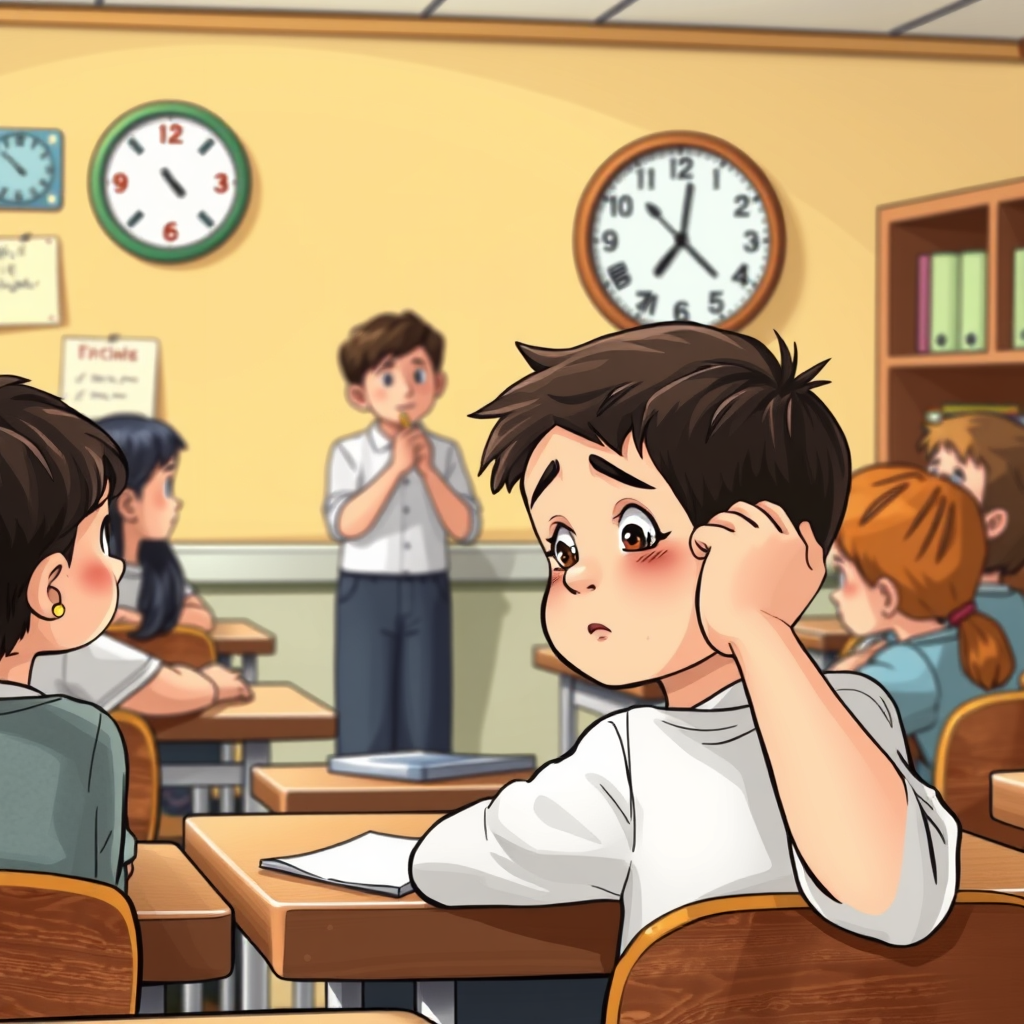
not interesting; makes you feel tired
I think that TV show is really boring.
More examples: The lesson was long and boring. • Waiting in line is boring. • He fell asleep during the boring movie.
Common collocations: a boring lesson, really boring, feel bored
Word family: boring (adjective), bored (adjective), bore (verb)
Synonyms: dull, not interesting, tiring
Antonyms: interesting, exciting, fun
Related concepts: bored, sleepy, class
Contexts: school, movies, free time
Usage note: Important difference: boring describes the thing, bored describes how you feel. 'I am bored' not 'I am boring'.
subject
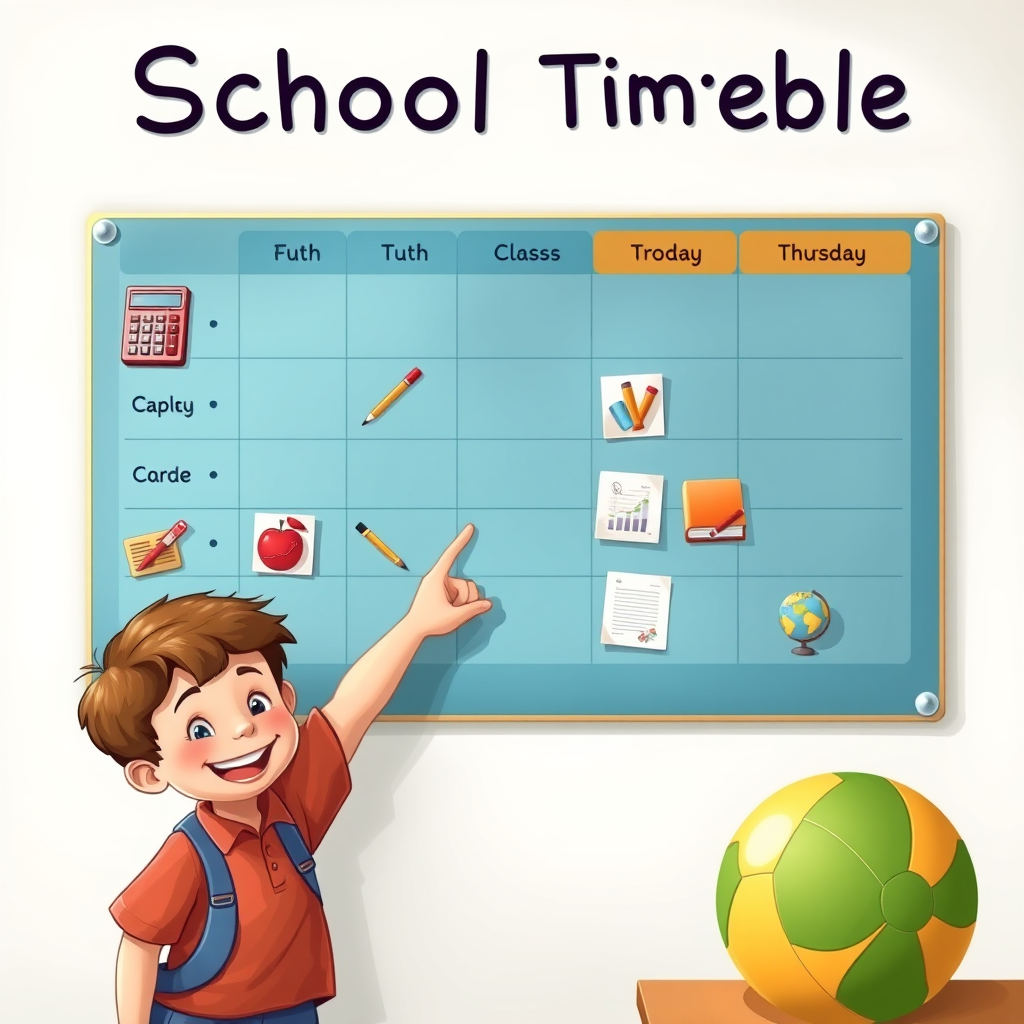
one thing you study at school, like math or art
How many subjects do you have at school?
More examples: My best subject is science. • We study five subjects today. • Which subject do you like least?
Common collocations: favourite subject, school subject, a difficult subject
Word family: subject (noun)
Synonyms: class, course, topic
Related concepts: school, study, lesson
Contexts: school, timetable, study
Usage note: Use it to name the things you study: math, English, art, PE, history.
Vocabulary Check
- What does 'struggle' mean?
- To find something very hard to do
- To get a good mark
- To like something a lot
- To finish quickly
- Which sentence uses 'grade' correctly?
- I grade basketball every day.
- I got a good grade on my test.
- My grade is my best friend.
- She grades to school by bus.
- What does 'boring' mean?
- Very fun
- Not interesting
- Very hard
- Very new
- In which situation would you use 'subject'?
- When you talk about a mark on a test
- When you talk about math or art at school
- When you talk about your best friend
- When you talk about a sport game
- Which sentence uses 'favourite' correctly?
- My favourite subject is science.
- I favourite my homework yesterday.
- The favourite is very long.
- He favourite at seven o'clock.
Language Practice: Talking About Subjects
Practice expressing your opinions about school subjects.
- Saying which subject you like most
- Emerging: My favourite subject is ___. — My favourite subject is science.
- Developing: My favourite subject is ___ because ___. — My favourite subject is science because I love experiments.
- Expanding: I really like ___, but my favourite subject is ___ because ___. — I really like math, but my favourite subject is science because experiments are fun and exciting.
- Talking about subjects that are hard
- Emerging: I struggle with ___. — I struggle with English.
- Developing: I struggle with ___ because ___. — I struggle with English because there are many new words.
- Expanding: I am good at ___, but I struggle with ___ because ___. — I am good at science, but I struggle with English because reading long texts is hard for me.
- Giving opinions about subjects
- Emerging: I think ___ is ___. — I think math is interesting.
- Developing: I think ___ is ___ because ___. — I think math is interesting because I like numbers.
- Expanding: Some people think ___ is ___, but I think it is ___ because ___. — Some people think math is boring, but I think it is interesting because I love solving problems.
Fill in the Blanks
Mia loves school, but not every class is the same for her. Her _____ subject is art because she loves to draw and paint. She always gets a good _____ in art class. But she _____s with math. The numbers are hard for her, and homework takes a long time. She thinks math homework is _____, so she does it slowly. Math is her least favourite _____, but she never gives up. Her teacher says she is getting better every week.
Word bank: favourite, grade, struggle, boring, subject
Sentence Unscramble
- favourite / my / is / subject / science
- struggle / i / with / english / sometimes
- got / a / good / grade / she / on / her / test
Discussion Questions
Every student has one subject they love. Maybe it is fun, maybe the teacher is great, or maybe you are just good at it. Leo loves science because of the experiments.
What is your favourite subject at school? What do you do in that class?
Everyone has a subject that feels hard. Leo struggles with English because reading is difficult for him. Struggling does not mean you are bad at it; it just means you need more practice.
Which subject do you struggle with the most? Why is it hard for you?
Some classes are exciting and time goes fast. Other classes feel long and boring, and you keep looking at the clock. Leo thinks history is a little boring.
Which subject is a little boring for you? What would make it more interesting?
Grades show how we did on a test. Leo got 98 on his math test and felt very proud. Sometimes we get grades that make us happy, and sometimes not.
Tell me about a grade that made you happy or sad. What happened?
Imagine you are the teacher for one day. You can change the lessons, the games, everything. Leo would do more experiments in science class.
If you were a teacher, how would you teach your favourite subject? What fun things would students do in your class?
Knowledge Check
- Which word means 'the one you like the most'?
- boring
- struggle
- favourite
- grade
- Leo got 98 on his math test. What did he get?
- A boring lesson
- A good grade
- A new subject
- A struggle
- True or false: 'I am boring' and 'I am bored' mean the same thing.
- True
- False
- Which phrase is correct?
- struggle to English
- struggle with English
- struggle English
- struggle at English
- Math, art, and science are all examples of a...
- grade
- struggle
- favourite
- subject
Free to use with your students: Free to teach, screen-share, print and share with your students, with a credit to PlanWise ESL. Please do not sell it or republish it as your own. What you can do with free lessons.