Dealing with Lost Luggage and Flight Delays Calmly
About this lesson: This is an A2 (Elementary) ESL lesson in the General English category. It takes about 60 minutes. It includes 5 vocabulary words, a reading text, comprehension questions, discussion questions and speaking patterns. Suits one-to-one or small-group online classes. Free to open and teach with no login, and it prints as a PDF.
Print just the discussion questions
How this lesson is built
This is a complete conversation lesson built on a scientific pedagogical formula, not a generic worksheet: recall prior topic vocabulary, pre-teach the new words in depth, read in context, practise active recall with flashcards and synonyms/antonyms, build accuracy with exercises, and finish with deep discussion.
- Warm-up: Discussion questions that connect the topic to the student’s own life and recall vocabulary they already know about the subject.
- Reading: A text written for this CEFR level that uses each new word two or three times in context, giving the student something meaningful to react to.
- Key vocabulary: 5 new words, pre-taught before the reading with a definition, pronunciation guide, example sentences and a picture, plus word families, usage notes, recall flashcards and synonyms/antonyms, giving a solid grounding before reading.
- Comprehension: 5 questions that check the new words: retrieval practice, not rereading.
- Sentence frames: 3 speaking patterns, each at three levels of support (emerging, developing, expanding) with model answers—especially helpful scaffolding for beginners and less confident speakers.
- Gap-fill: The new words again, in a shuffled order, so the student recalls them by meaning in context.
- Sentence unscramble: Natural sentences with the new words to put back in order, reinforcing grammar and collocation.
- Discussion: 5 open questions designed to talk deeply about the subject while actively using the lesson’s target vocabulary: the heart of a conversation lesson.
- Quiz: A short retrieval check that brings every new word back once more.
Unlike a generic worksheet, the new words are taught before the reading and met again in the activities, the speaking is supported at three levels and most of the time goes on the student talking. Teachers who use PlanWise ESL also get per-student vocabulary tracking (recycling earlier words into future readings and questions), a private learner dashboard with flashcards and custom lesson creation, and a downloadable study PDF.
Warm-up: Talk About Travel
Look at the pictures and talk about flying and travel problems.
- Do you like flying? Why or why not?
- When you travel, what do you put in your bag?
- Have you ever waited a long time at an airport?
- What do you do when something goes wrong on a trip?
- Do you get angry easily, or do you stay relaxed?
Reading Text: A Bad Day at the Airport
Read about Marco's trip. He had some problems, but he stayed relaxed.
Last month, Marco flew to visit his sister. His flight had a big delay. He waited at the airport for four hours. He was tired, but he stayed calm.
At first, Marco wanted to complain to the airline. But he thought about it. He decided to wait and see. He read a book and drank coffee.
When the plane finally left, Marco felt happy. But there was one more problem. His luggage did not arrive! He waited at the belt, but his big blue bag never came.
Marco went to the desk. The man there said sorry. He apologized many times. He said, 'We will find your bag and bring it to your hotel.'
The next day, the bag arrived. Marco got his clothes back. He was not angry anymore. He learned that a calm person solves problems faster than an angry person.
Key Vocabulary
delay

a wait; something happens later than planned
Our flight had a two-hour delay.
More examples: There was a delay because of the rain. • Sorry for the delay in my answer. • I don't like delays when I travel.
Common collocations: a long delay, flight delay, cause a delay
Word family: delay (noun), delay (verb)
Synonyms: wait, late time, hold-up
Antonyms: on time, early
Related concepts: airport, schedule, traffic
Contexts: airports, trains, work emails
Usage note: Use for planes, trains, buses, or answers that come late. Very common at airports.
luggage
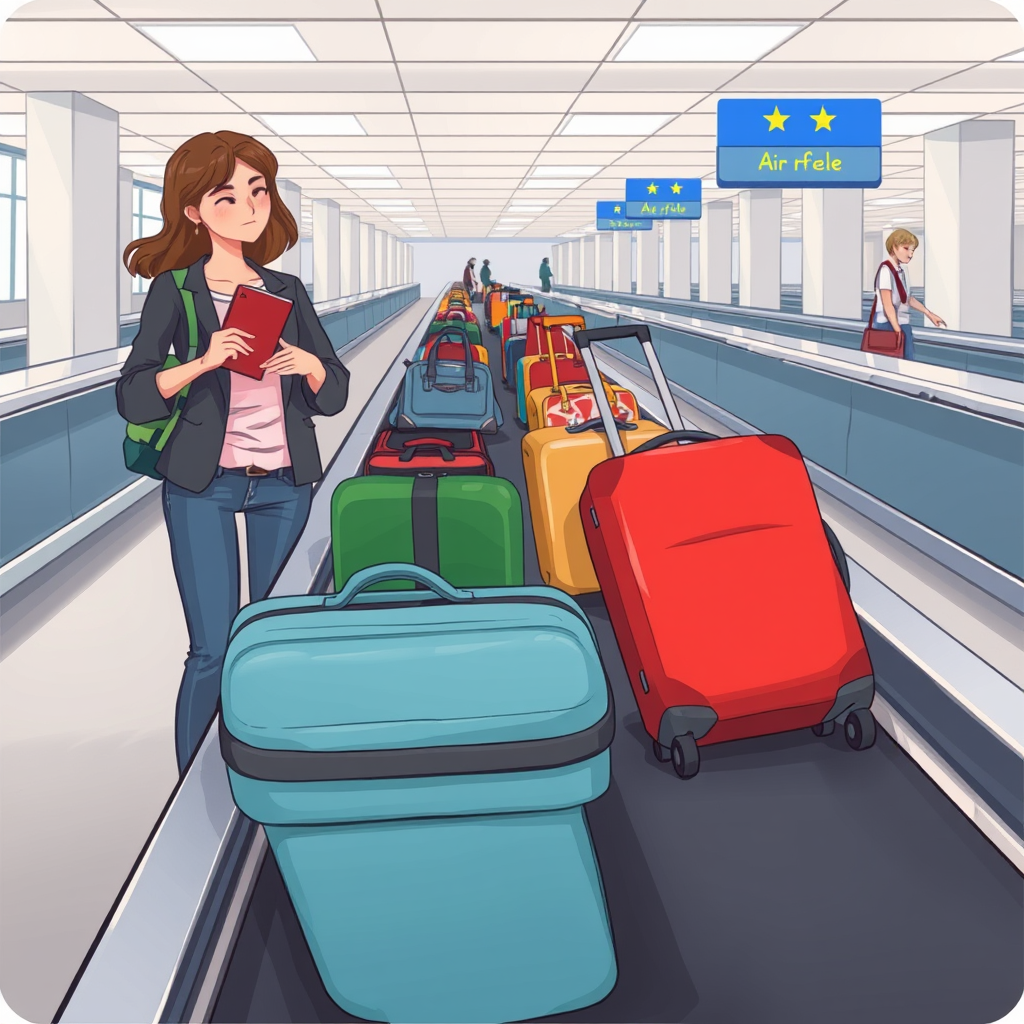
the bags you take when you travel
I lost my luggage at the airport.
More examples: My luggage is heavy. • Please wait for your luggage here. • She travels with only one piece of luggage.
Common collocations: carry luggage, lose luggage, heavy luggage
Word family: luggage, bag, baggage
Synonyms: bags, suitcases, baggage
Antonyms: hand luggage (small bag)
Related concepts: suitcase, airport, packing
Contexts: airports, hotels, trains
Usage note: Luggage is uncountable. Say 'a piece of luggage' or 'two bags', not 'two luggages'.
calm
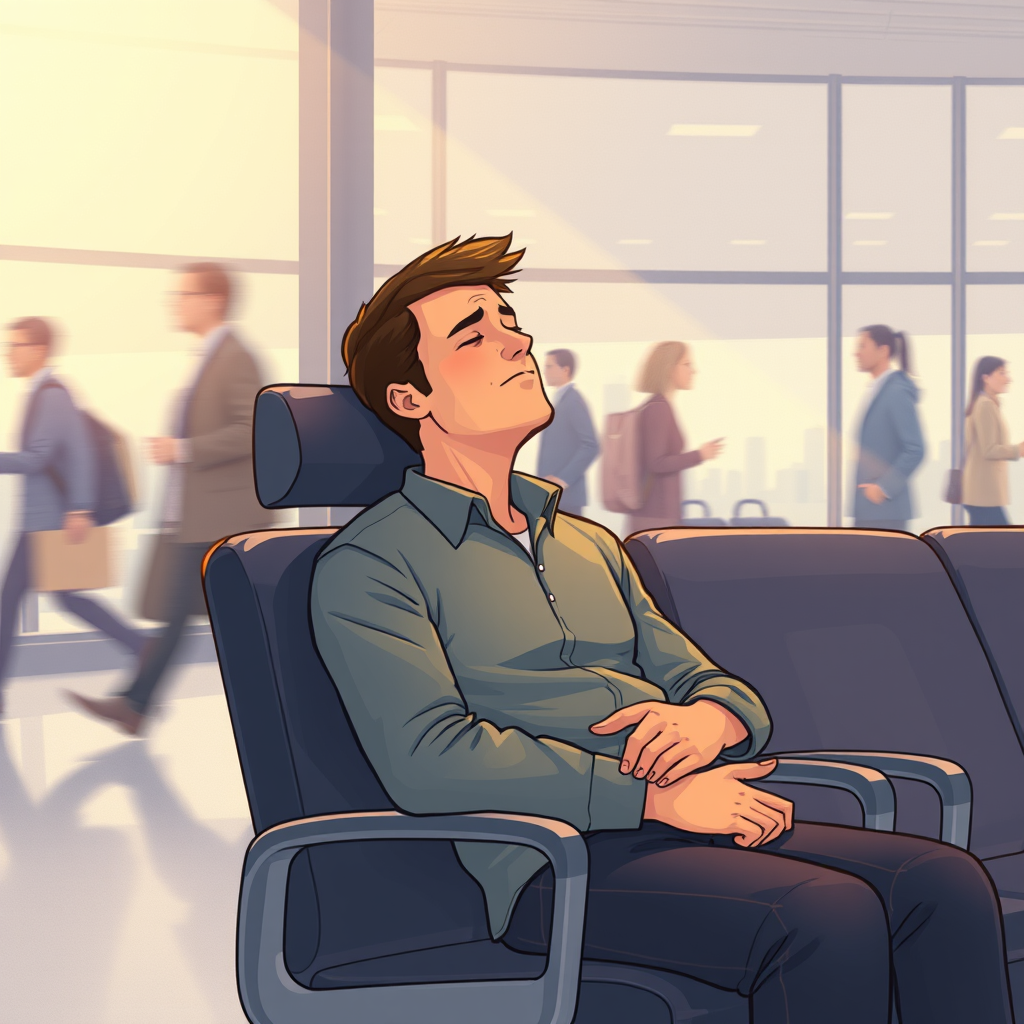
relaxed, not angry or worried
She stayed calm when the flight was late.
More examples: Please be calm; everything is okay. • He spoke in a calm voice. • I feel calm near the sea.
Common collocations: stay calm, keep calm, calm voice
Word family: calm (adjective), calmly (adverb), calm down (verb phrase)
Synonyms: relaxed, quiet, peaceful
Antonyms: angry, nervous, stressed
Related concepts: patience, breathing, relax
Contexts: travel problems, arguments, before tests
Usage note: Use for people and places. 'Calm down' is what you say to someone who is angry or upset.
complain
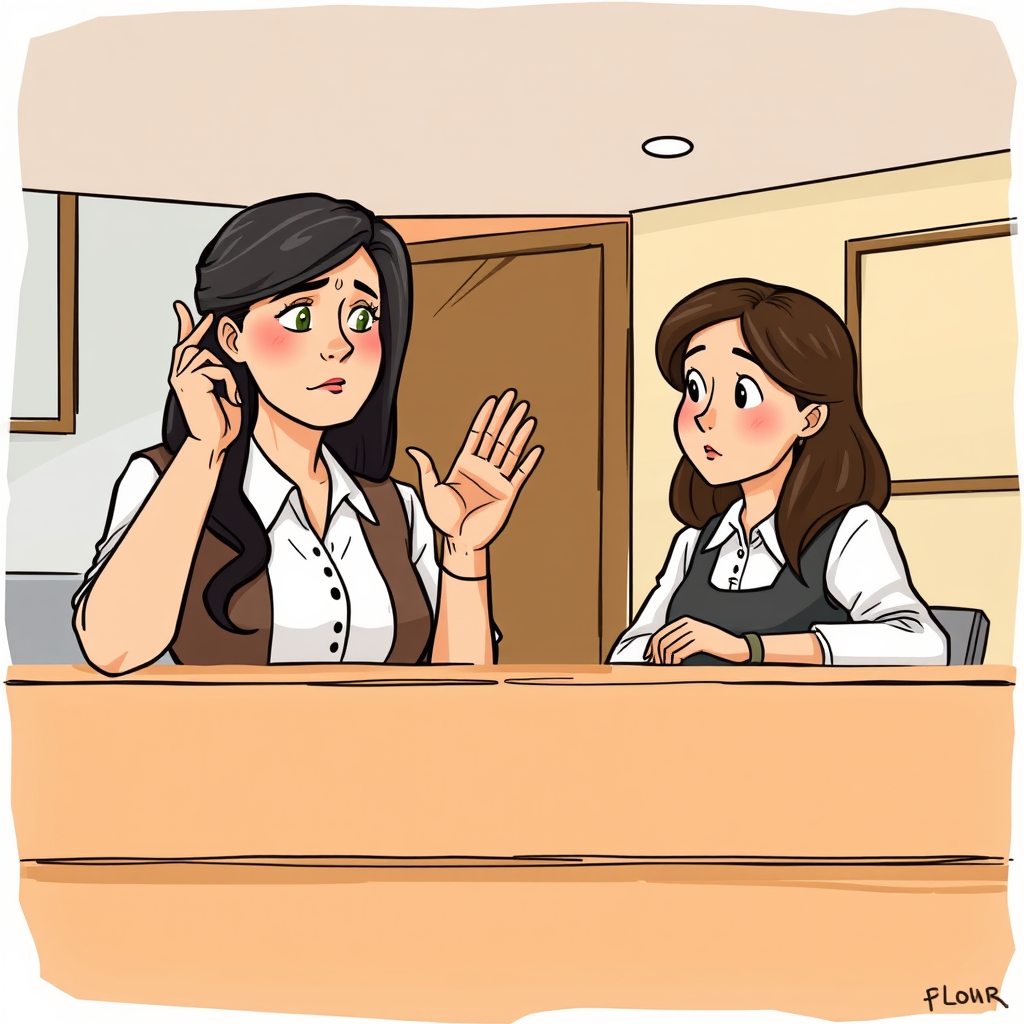
to say you are not happy about something
He wanted to complain about the long wait.
More examples: Don't complain; the food is fine. • She complained to the manager. • I complain too much about my job.
Common collocations: complain about something, complain to someone, make a complaint
Word family: complain (verb), complaint (noun)
Synonyms: say you are unhappy, protest, grumble
Antonyms: praise, accept
Related concepts: problem, service, manager
Contexts: hotels, restaurants, airlines
Usage note: Use 'complain about' a thing and 'complain to' a person. It often shows you are unhappy.
apologize
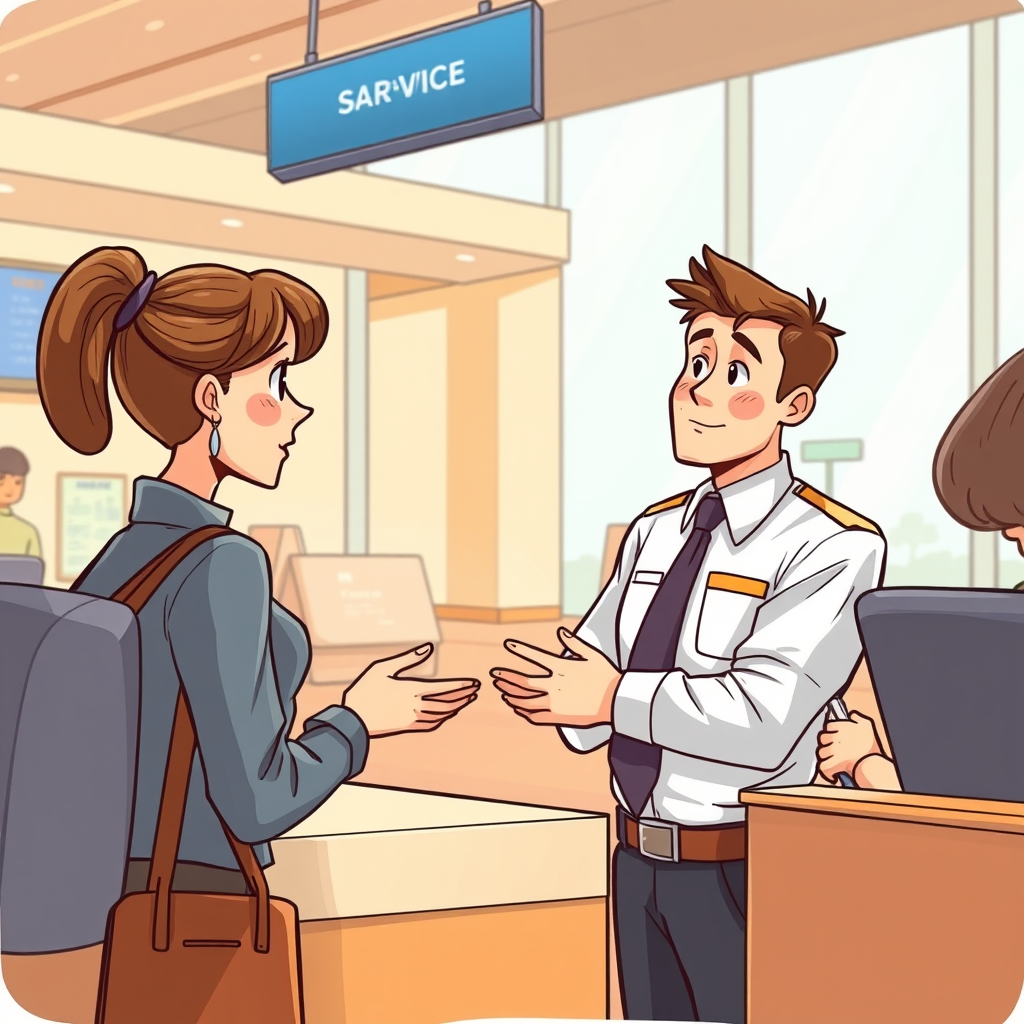
to say sorry for something
The airline apologized for the delay.
More examples: I apologized for being late. • He apologized to his friend. • They apologized many times.
Common collocations: apologize for something, apologize to someone, say you apologize
Word family: apologize (verb), apology (noun)
Synonyms: say sorry, say sorry for a mistake
Antonyms: blame, refuse to say sorry
Related concepts: sorry, mistake, polite
Contexts: work, family, customer service
Usage note: Use 'apologize for' a mistake and 'apologize to' a person. More formal than just 'sorry'.
Vocabulary Check
- What does 'luggage' mean?
- The bags you take when you travel
- A ticket for a plane
- Money for a trip
- A seat on a plane
- Which sentence uses 'delay' correctly?
- The delay was very delicious.
- Our flight had a delay of two hours.
- I delay my luggage every day.
- She delayed a sandwich for lunch.
- If you 'complain', what do you do?
- You say thank you
- You say you are happy
- You say you are not happy about something
- You buy a ticket
- What does 'apologize' mean?
- To say hello
- To say sorry
- To say goodbye
- To ask a question
- In which situation would you 'stay calm'?
- When you win a prize
- When your flight is late and you feel angry
- When you eat your favorite food
- When you see a friend
Language Practice: Travel Problems
Practice talking about travel problems and staying relaxed.
- Describing a travel problem
- Emerging: There was a ___. — There was a delay.
- Developing: Last year, there was a ___ and I ___. — Last year, there was a delay and I waited three hours.
- Expanding: When there was a ___, I decided to ___ because ___. — When there was a delay, I decided to stay calm because anger doesn't help.
- Giving an opinion about staying calm
- Emerging: I think it is better to ___. — I think it is better to wait.
- Developing: I think staying ___ is more ___ than ___. — I think staying calm is more useful than getting angry.
- Expanding: In my opinion, when something goes wrong, it is better to ___ than to ___ because ___. — In my opinion, when something goes wrong, it is better to stay calm than to complain loudly because people help calm people faster.
- Apologizing and responding to problems
- Emerging: I apologize for the ___. — I apologize for the delay.
- Developing: I apologize for the ___. Can I help you with ___? — I apologize for the delay. Can I help you with your luggage?
- Expanding: I apologize for the ___. I know it is ___ , and I would like to ___. — I apologize for the delay. I know it is frustrating, and I would like to give you a free drink.
Fill in the Blanks
Anna took a train to visit her cousin in another city. Sadly, there was a long _____ because of snow. Anna stayed _____ and called her cousin. 'I'm sorry,' she said, and she _____d for coming late. At the station, she picked up her heavy _____ and looked for a taxi. A man next to her started to _____ loudly about the train, but Anna just smiled and waited her turn.
Word bank: delay, calm, apologize, luggage, complain
Sentence Unscramble
- our / flight / had / a / long / delay / yesterday
- she / stayed / calm / and / waited / for / her / luggage
- the / man / apologized / for / the / problem / at / the / desk
Discussion Questions
Sometimes flights and trains are late. People wait for hours at airports and stations. Some people get angry, and some people stay relaxed. Everyone reacts in a different way.
Have you ever had a delay when you traveled? What did you do while you waited?
Imagine you arrive after a long flight, but your big bag does not come. Your clothes, your gifts, everything is in that bag. This happens to many travelers every year.
If the airline lost your luggage, would you complain loudly or stay calm? Why?
When there is a problem, some people complain immediately. Other people wait, breathe, and think first. There are good and bad points to both ways.
Which is better when something goes wrong: complain fast or wait and think? Why?
When a company makes a mistake, a good worker says sorry. A good apology can change a bad situation into a good one. But not everyone says sorry in the same way.
When was the last time you apologized to someone? What happened?
Some people love the excitement of airports and new places. Other people find flying stressful and prefer trains or cars. There is no right answer.
Do you enjoy traveling, or is it stressful for you? What is the best part and the worst part?
Knowledge Check
- What is 'luggage'?
- A plane ticket
- Travel bags and suitcases
- A hotel room
- A travel document
- True or false: 'calm' means angry and worried.
- True
- False
- Which phrase is correct?
- complain to the manager about the noise
- complain the manager to the noise
- complain about to the noise
- complain the noise
- The airline said sorry many times. This means the airline ___.
- complained
- apologized
- delayed
- packed
- True or false: 'a delay' means something happens earlier than planned.
- True
- False
Free to use with your students: Free to teach, screen-share, print and share with your students, with a credit to PlanWise ESL. Please do not sell it or republish it as your own. What you can do with free lessons.