Patient Handovers: How Doctors Pass the Baton
About this lesson: This is a B2 (Upper Intermediate) ESL lesson in the General English category. It takes about 60 minutes. It includes 5 vocabulary words, 4 idioms and phrasal verbs, a reading text, comprehension questions, discussion questions and speaking patterns. Suits one-to-one or small-group online classes. Free to open and teach with no login, and it prints as a PDF.
Print just the discussion questions
How this lesson is built
This is a complete conversation lesson built on a scientific pedagogical formula, not a generic worksheet: recall prior topic vocabulary, pre-teach the new words in depth, read in context, practise active recall with flashcards and synonyms/antonyms, build accuracy with exercises, and finish with deep discussion.
- Warm-up: Discussion questions that connect the topic to the student’s own life and recall vocabulary they already know about the subject.
- Reading: A text written for this CEFR level that uses each new word two or three times in context, giving the student something meaningful to react to.
- Key vocabulary: 5 new words, pre-taught before the reading with a definition, pronunciation guide, example sentences and a picture, plus word families, usage notes, recall flashcards and synonyms/antonyms, giving a solid grounding before reading.
- Comprehension: 5 questions that check the new words: retrieval practice, not rereading.
- Idioms and phrasal verbs: Expressions taken from the reading, each with its meaning, an example and a speaking question.
- Sentence frames: 3 speaking patterns, each at three levels of support (emerging, developing, expanding) with model answers—especially helpful scaffolding for beginners and less confident speakers.
- Gap-fill: The new words again, in a shuffled order, so the student recalls them by meaning in context.
- Sentence unscramble: Natural sentences with the new words to put back in order, reinforcing grammar and collocation.
- Discussion: 5 open questions designed to talk deeply about the subject while actively using the lesson’s target vocabulary: the heart of a conversation lesson.
- Quiz: A short retrieval check that brings every new word back once more.
Unlike a generic worksheet, the new words are taught before the reading and met again in the activities, the speaking is supported at three levels and most of the time goes on the student talking. Teachers who use PlanWise ESL also get per-student vocabulary tracking (recycling earlier words into future readings and questions), a private learner dashboard with flashcards and custom lesson creation, and a downloadable study PDF.
Warm-up Activity
Talk about times when important information gets passed from one person to another, and what can go wrong.
- Have you ever had to explain something important to someone who was taking over from you, at work or at home?
- When someone gives you instructions, do you prefer them written down or spoken? Why?
- Have you ever had a message get lost between two people? What happened?
- Do you think doctors and nurses talk to each other enough when they change shifts?
- If you were in hospital, what would you want the staff to know about you before they started treating you?
Reading Text: The Five Minutes That Keep Patients Safe
Every day in hospitals around the world, doctors and nurses change shifts. Those few minutes of passing information can make a huge difference. Let's find out why.
It is seven in the morning at a busy city hospital. The night nurses are finishing their shift, and the day team is arriving with fresh coffee. Before anyone goes home, there is a handover: a short meeting where the night team tells the day team exactly what happened with each patient. It sounds simple, but these few minutes are some of the most important of the whole day.
During the handover, the night nurse gives a briefing on every patient. She mentions who is stable, who is getting worse, and which tests are still waiting for results. If the information is not accurate, the day team might give the wrong medicine or miss a warning sign. Studies show that communication problems at handover cause a surprising number of medical mistakes.
Take the case of Mr. Alvarez, a patient recovering from surgery. During the night, his temperature rose slightly. The night nurse noticed it and mentioned it in her briefing. Because the day doctor knew about it, she checked on him early and caught an infection before it became critical. One clear sentence at handover probably saved his life.
Not every hospital does handovers the same way. Some use a written checklist; others prefer a spoken summary at the patient's bedside. Some hospitals now invite patients and families to join the handover, so everyone hears the same information. Supporters of bedside handovers say patients can correct mistakes on the spot. Critics worry that private details get shared in front of other people.
Experts agree on one thing: handovers need structure. A popular method reminds staff to cover the patient's history, current treatment, and any critical changes to watch for. The best handovers also leave time for questions, so the incoming team can check anything unclear. As one senior doctor put it, 'A good handover is like passing a baton in a relay race. If you drop it, everyone loses.'
Key Vocabulary
handover

the moment when one person gives their job or information to another
The morning handover takes about twenty minutes.
More examples: There was a mix-up during the handover between shifts. • The handover went smoothly because the notes were clear. • I always write a list before the handover so I forget nothing.
Common collocations: do a handover, during the handover, a smooth handover
Word family: hand over (phrasal verb), handover (noun)
Synonyms: transfer, passing on, changeover
Antonyms: keeping, holding on
Related concepts: shift change, teamwork, instructions
Contexts: hospitals, police stations, factories
Usage note: Common at work, especially in hospitals, police, and jobs with shifts. Also used for handing over power or control, like a change of government.
briefing

a short meeting where you give someone the key facts
The manager gives a briefing before every shift starts.
More examples: We had a quick briefing about the new safety rules. • The pilot attended a weather briefing before the flight. • Can you give me a briefing on what I missed yesterday?
Common collocations: give a briefing, attend a briefing, a quick briefing
Word family: brief (adjective), brief (verb), briefing (noun)
Synonyms: update, run-through, summary
Antonyms: long discussion, debate
Related concepts: instructions, meetings, reports
Contexts: workplaces, hospitals, the military
Usage note: Used at work, in the military, police, aviation and business. A briefing is usually short and focused on the most important points.
shift
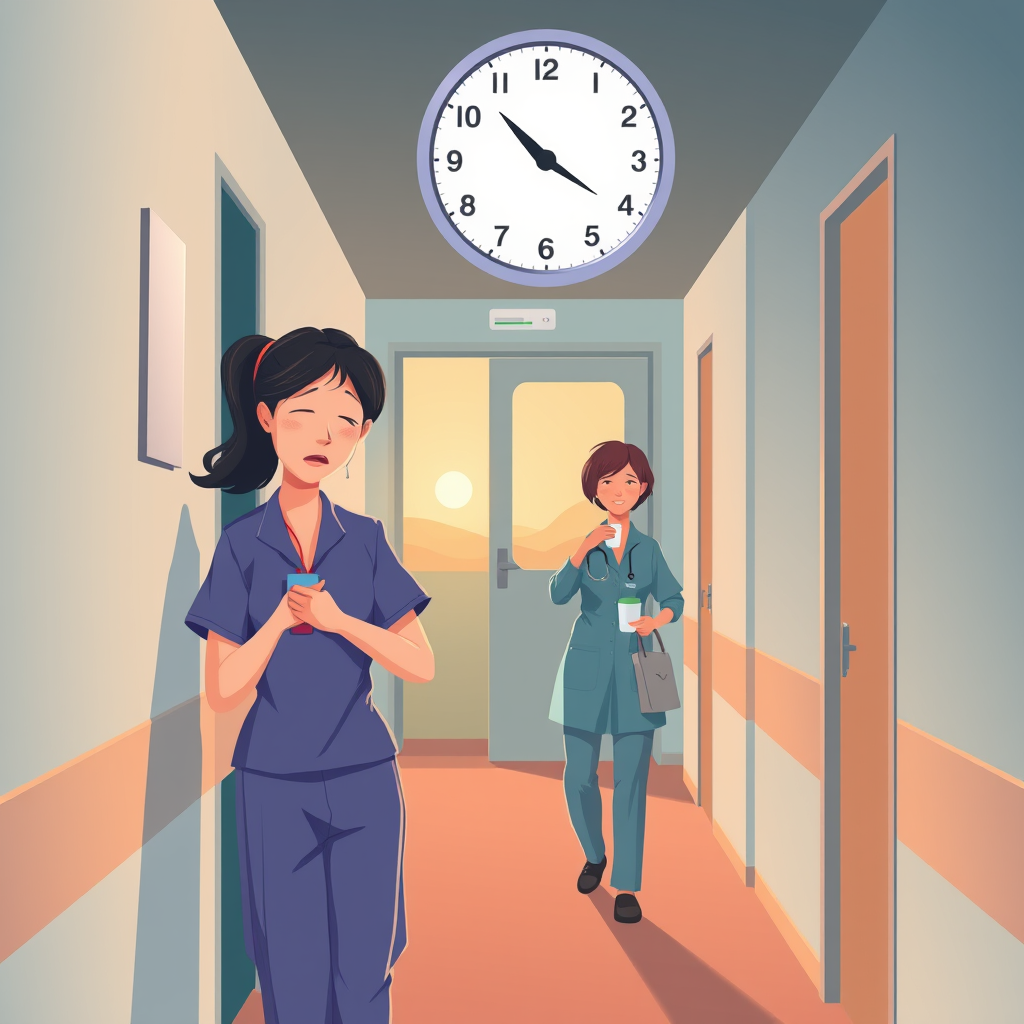
a period of work, for example at night or in the morning
She works the night shift three times a week.
More examples: My shift starts at six in the evening. • He was tired after a twelve-hour shift. • The nurses change shift at eight o'clock.
Common collocations: work the night shift, start a shift, a twelve-hour shift
Word family: shift (noun), shift work (noun), shiftless (adjective, rare)
Synonyms: work period, rota slot, duty
Antonyms: day off, free time
Related concepts: overtime, rota, working hours
Contexts: hospitals, factories, restaurants
Usage note: Very common when talking about hospital, factory, or service jobs. Note the verb 'change shift' without an -s.
critical

extremely important, or dangerously serious
The patient's condition became critical overnight.
More examples: Good timing is critical in an emergency. • She was in a critical condition after the accident. • This is a critical moment for the company.
Common collocations: critical condition, a critical moment, critically important
Word family: critically (adverb), critic (noun), criticize (verb)
Synonyms: crucial, vital, serious
Antonyms: minor, unimportant
Related concepts: emergency, importance, risk
Contexts: medicine, news reports, business
Usage note: Two main meanings: 'extremely important' and 'dangerously ill' (in medicine). Context tells you which one. Don't confuse with 'critical of someone', which means judging them negatively.
accurate

correct and exact, without mistakes
Make sure the patient's details are accurate before you write them down.
More examples: The weather forecast was surprisingly accurate. • Please give me your accurate arrival time, not a guess. • The report was accurate except for one small date.
Common collocations: accurate information, an accurate description, highly accurate
Word family: accurately (adverb), accuracy (noun), inaccurate (adjective)
Synonyms: exact, precise, correct
Antonyms: inaccurate, wrong, vague
Related concepts: details, facts, checking
Contexts: medicine, science, journalism
Usage note: Used for facts, measurements, information and copies. Stronger than 'correct': it suggests every detail is right.
Vocabulary Check
- What does 'handover' mean?
- A long report written by a manager
- The moment one person gives their job or information to another
- A kind of medical test
- A break between two work periods
- Which sentence uses 'briefing' correctly?
- The briefing lasted three hours and covered everything in detail.
- She gave us a quick briefing on the new rules before we started.
- I bought a briefing at the supermarket.
- He was briefing because he had slept badly.
- In which situation would you use the word 'shift'?
- Describing the hours you work at a hospital job
- Describing a holiday abroad
- Describing a type of medicine
- Describing a school subject
- What does 'critical' mean in this sentence: 'The patient was in critical condition'?
- The patient was very relaxed
- The patient was about to leave the hospital
- The patient was dangerously ill
- The patient was angry with the staff
- Which sentence uses 'accurate' correctly?
- The map was accurate, so we found the house easily.
- He felt accurate after the long journey.
- The soup tasted very accurate.
- She wore an accurate dress to the party.
Idioms & Phrasal Verbs
check on
go and see if someone is okay
Can you check on the soup? I think it's burning.
Usage note: You check ON someone or something, not just 'check someone'. · Right: I checked on my grandmother · Avoid: I checked my grandmother
get worse
become more bad or serious
My cold got worse over the weekend, so I stayed in bed.
Usage note: The opposite is 'get better'. Change 'get' for tense: got worse, is getting worse.
on the spot
immediately, right there
If I say a word wrong, my friend corrects me on the spot.
Usage note: Picture the moment: you fix the problem exactly where you're standing, not later. It can also mean 'suddenly put in a difficult situation': 'His question put me on the spot'.
drop the baton
fail to pass information or responsibility correctly
I told Carlos to email the client, but he dropped the baton and nobody sent it.
Usage note: Picture a relay race: if a runner drops the baton, the whole team loses, even if everyone else ran well. The opposite idea is 'pass the baton' - hand a job to the next person.
Language Practice: Handovers and Communication
Practice expressing ideas about passing on information and teamwork.
- Comparing different views
- Emerging: Some people say ___, but I think ___. — Some people say written notes are enough, but I think speaking is better.
- Developing: Some people prefer ___, while others think ___. In my experience, ___. — Some people prefer bedside handovers, while others think they're too public. In my experience, privacy matters a lot.
- Expanding: Although ___ works well for some people, I'd argue that ___, especially when ___. — Although bedside handovers work well for some people, I'd argue that private briefings are safer, especially when the information is personal.
- Weighing pros and cons
- Emerging: The good thing about ___ is ___. The bad thing is ___. — The good thing about night shifts is the extra pay. The bad thing is the tiredness.
- Developing: One advantage of ___ is that ___. On the other hand, ___. — One advantage of bedside handovers is that patients can correct mistakes. On the other hand, privacy can suffer.
- Expanding: The main benefit of ___ is that ___, although you could also say that ___, which is why ___. — The main benefit of bedside handovers is that patients feel involved, although you could also say it exposes private details, which is why some hospitals ask permission first.
- Imagining situations
- Emerging: If I ___, I would ___. — If I forgot something important, I would write it down next time.
- Developing: If I were ___, I would ___ because ___. — If I were the night nurse, I would mention the fever because small details matter.
- Expanding: If I ___, I would probably ___, and if that didn't work, I'd ___. — If I forgot a detail at handover, I would probably call the previous nurse, and if that didn't work, I'd check the patient's notes myself.
Fill in the Blanks
Last month, Marta started a new job at a large hospital. On her first day, she joined the morning _____, where the night team explained everything that had happened. She learned that she would work the evening _____, finishing at eleven. Her supervisor explained that the _____ between teams was the most _____ part of the day, because one wrong detail could cause a serious mistake. 'Always make sure your notes are _____,' the supervisor said, 'and never be afraid to ask questions.' Marta wrote this advice in her notebook and still follows it today.
Word bank: handover, briefing, shift, critical, accurate
Sentence Unscramble
- the / night / nurse / gave / a / clear / briefing / before / she / left
- accurate / information / at / handover / can / save / lives
- his / condition / became / critical / during / the / night / shift
Discussion Questions
Imagine you have worked on a project for weeks, and tomorrow a colleague takes it over. You have one meeting to tell them everything: what's done, what's broken, and what to watch out for. Some people write long documents; others just talk it through.
How would you handle that handover, and what's the biggest risk of getting it wrong?
In the reading, a nurse mentioned a small fever at handover, and that one sentence probably saved a life. Small details often matter more than we expect, in hospitals and in everyday life too.
Can you think of a time when a small detail made a big difference for you? What happened?
Some hospitals now hold handovers at the patient's bedside, so patients and families hear everything and can correct mistakes. Critics say private information shouldn't be discussed in front of a whole ward.
Would you want to be part of your own handover as a patient, or would you prefer the staff to talk privately? Why?
Night shifts are hard: your body clock is confused, you're tired, and you still have to give an accurate handover at the end. Many essential workers, from nurses to bakers to airport staff, work these hours.
Do you think you could work night shifts? What would be the hardest part for you?
One doctor compared a handover to passing a baton in a relay race: if you drop it, everyone loses. The same idea applies to many jobs, and even to families, where messages get passed between busy people.
Where else in life do we 'drop the baton' when passing information? Can you give an example from your own experience?
Knowledge Check
- What happens during a hospital handover?
- Patients are moved to a new room
- One team passes information about patients to the next team
- Doctors perform an operation
- The hospital closes for cleaning
- True or false: a briefing is usually a long, detailed meeting.
- True
- False
- Which word means 'correct and exact, without mistakes'?
- Critical
- Shift
- Accurate
- Handover
- If a patient is in 'critical condition', they are...
- Ready to go home
- Dangerously ill
- Feeling much better
- Waiting for lunch
- True or false: 'shift' can mean the period of time you work, like the night shift.
- True
- False
- If your manager says 'Don't drop the baton on this project', what does she want you to do?
- Finish the project as fast as possible
- Pass the work on carefully so nothing gets lost
- Throw the project away and start again
- Do the whole project alone
Free to use with your students: Free to teach, screen-share, print and share with your students, with a credit to PlanWise ESL. Please do not sell it or republish it as your own. What you can do with free lessons.