Handing Over the Shift: Clear Hospital Briefings
About this lesson: This is a B2 (Upper Intermediate) ESL lesson in the General English category. It takes about 60 minutes. It includes 5 vocabulary words, 4 idioms and phrasal verbs, a reading text, comprehension questions, discussion questions and speaking patterns. Suits one-to-one or small-group online classes. Free to open and teach with no login, and it prints as a PDF.
Print just the discussion questions
How this lesson is built
This is a complete conversation lesson built on a scientific pedagogical formula, not a generic worksheet: recall prior topic vocabulary, pre-teach the new words in depth, read in context, practise active recall with flashcards and synonyms/antonyms, build accuracy with exercises, and finish with deep discussion.
- Warm-up: Discussion questions that connect the topic to the student’s own life and recall vocabulary they already know about the subject.
- Reading: A text written for this CEFR level that uses each new word two or three times in context, giving the student something meaningful to react to.
- Key vocabulary: 5 new words, pre-taught before the reading with a definition, pronunciation guide, example sentences and a picture, plus word families, usage notes, recall flashcards and synonyms/antonyms, giving a solid grounding before reading.
- Comprehension: 5 questions that check the new words: retrieval practice, not rereading.
- Idioms and phrasal verbs: Expressions taken from the reading, each with its meaning, an example and a speaking question.
- Sentence frames: 3 speaking patterns, each at three levels of support (emerging, developing, expanding) with model answers—especially helpful scaffolding for beginners and less confident speakers.
- Gap-fill: The new words again, in a shuffled order, so the student recalls them by meaning in context.
- Sentence unscramble: Natural sentences with the new words to put back in order, reinforcing grammar and collocation.
- Discussion: 5 open questions designed to talk deeply about the subject while actively using the lesson’s target vocabulary: the heart of a conversation lesson.
- Quiz: A short retrieval check that brings every new word back once more.
Unlike a generic worksheet, the new words are taught before the reading and met again in the activities, the speaking is supported at three levels and most of the time goes on the student talking. Teachers who use PlanWise ESL also get per-student vocabulary tracking (recycling earlier words into future readings and questions), a private learner dashboard with flashcards and custom lesson creation, and a downloadable study PDF.
Warm-up Activity
Talk about passing on information at work or in daily life, and what makes a good handover of information.
- Have you ever had to pass important information from one person to another, at work or in daily life?
- When someone explains something to you quickly, what makes it easy or hard to follow?
- Do you prefer getting information face to face, in writing, or in a short message? Why?
- Have you ever missed an important detail because someone didn't explain it clearly? What happened?
- If you had to teach someone your job in five minutes, what would you say first?
Reading Text: Five Minutes That Keep Patients Safe
A short article about how nurses and doctors pass information between shifts, and why it matters so much.
At seven in the morning, the night shift ends and the day shift begins. In hospitals around the world, this moment is called the handover. Nurses and doctors gather together and pass on everything the next team needs to know. It sounds simple, but these few minutes can decide whether a patient has a safe day or a difficult one.
The problem is that tired people give unclear information. A nurse at the end of a twelve-hour shift might say a patient is 'a bit confused', without explaining when it started or what caused it. The morning team then has to guess. Good hospitals train staff to be concise: to say only what matters, but to say all of it.
Many hospitals now use a simple structure. Staff list the patient's main problems in order of priority, so the most urgent issue comes first. Then they give a quick update on anything that changed overnight, like a new medicine or a change in temperature. Finally, they clarify anything unclear on the spot, instead of leaving questions for later.
Not everyone agrees on the best method. Some senior doctors think long written notes are safer than short spoken briefings, because people forget things. Others argue that a face-to-face handover lets the new team ask questions immediately, and that talking builds trust between shifts. Most experts now say you need both: a short spoken briefing plus clear notes.
Patients rarely see these meetings, but they feel the results. When the handover goes well, the morning nurse already knows that Mrs. Lee hates needles, or that Mr. Osei's family is coming at noon. Small details like these make care feel personal. In the end, a good handover is really a promise: we know your story, and we will continue it carefully.
Key Vocabulary
handover

the moment when one person gives their work or duty to another
The night nurse gave a clear handover to the morning team.
More examples: The handover between shifts takes about fifteen minutes. • We did a proper handover before I left on holiday. • During the handover, she mentioned the patient's new medicine.
Common collocations: do a handover, shift handover, a smooth handover
Word family: hand over (phrasal verb), handed over
Synonyms: transfer, passing on, changeover
Antonyms: taking over, keeping
Related concepts: shifts, teamwork, briefing
Contexts: hospitals, offices, factories, police work
Usage note: Common at work, especially shifts, projects and jobs. One word as a noun; two words as a verb.
concise

short and clear, using few words but saying everything important
Keep your report concise so the whole team can read it quickly.
More examples: Her explanation was concise but complete. • Try to be concise when you leave the voice message. • A concise summary is harder to write than a long one.
Common collocations: a concise summary, keep it concise, concise instructions
Word family: concisely (adverb), conciseness (noun)
Synonyms: brief, to the point, short and clear
Antonyms: long-winded, wordy, rambling
Related concepts: clarity, summarizing, efficiency
Contexts: emails, presentations, reports, briefings
Usage note: A positive word, often used about writing and speaking at work. It means short AND complete, not just short.
priority
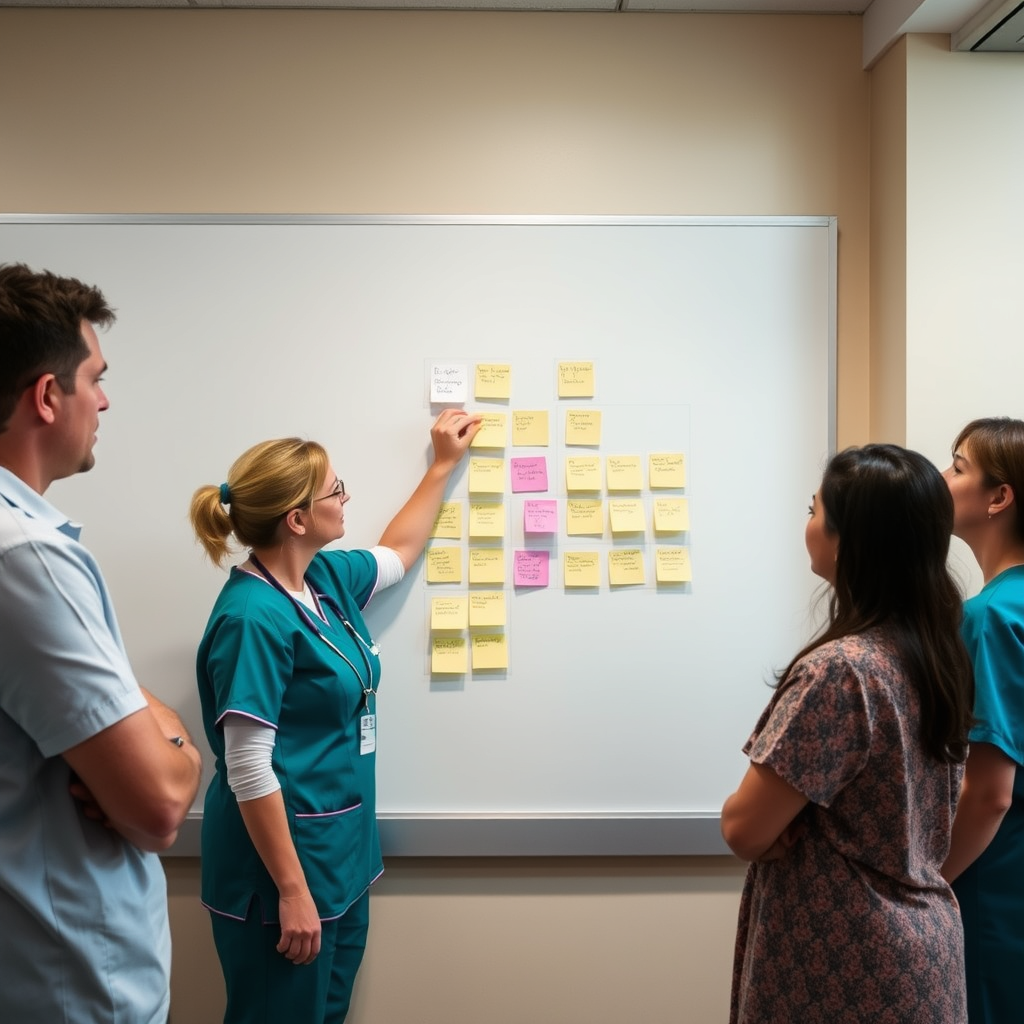
the thing that is most important and should be done first
Patient safety is our top priority during every shift.
More examples: My first priority this morning is checking the new patients. • We have too many tasks, so we need to set priorities. • Family comes first; that's always been her priority.
Common collocations: top priority, set priorities, a high priority
Word family: prioritize (verb), priorities (plural noun)
Synonyms: main concern, first thing, most important task
Antonyms: minor detail, low priority, afterthought
Related concepts: urgency, time management, planning
Contexts: work, hospitals, studying, family life
Usage note: Very common at work and in daily planning. Often used with 'top', 'main' or 'first'.
clarify

to make something easier to understand by explaining it more
Could you clarify what time the patient last took her medicine?
More examples: Let me clarify: the meeting is at three, not four. • He asked the doctor to clarify the test results. • I'm calling to clarify one small detail in your email.
Common collocations: clarify a point, clarify what you mean, to clarify matters
Word family: clarification (noun), clear (adjective)
Synonyms: explain, make clear, spell out
Antonyms: confuse, complicate, vague
Related concepts: questions, understanding, miscommunication
Contexts: meetings, emails, hospitals, phone calls
Usage note: Polite and professional way to ask for more information. Much softer than saying 'I don't understand'.
update

new information about something that has changed recently
The doctor gave us a quick update on the patient's condition.
More examples: Can you give me an update on the project? • I sent a short update to the whole team this morning. • There's been no update since yesterday, which worries me.
Common collocations: give an update, a quick update, a status update
Word family: update (verb), up-to-date (adjective)
Synonyms: news, latest information, report
Antonyms: old news, outdated information
Related concepts: progress, change, communication
Contexts: work, hospitals, apps, news
Usage note: Very common at work. As a noun it usually comes with 'give' or 'send'. Both noun and verb are stressed differently: UP-date (noun), up-DATE (verb).
Vocabulary Check
- What does 'handover' mean?
- A medical treatment for tired staff
- The moment when one person gives their work to another
- A long written report about a patient
- A break between two shifts
- Which sentence uses 'concise' correctly?
- Her concise answer took twenty minutes to finish.
- He was concise: he said everything important in three clear sentences.
- The concise patient refused to take her medicine.
- A concise report is one that is very long and detailed.
- In which situation would you talk about a 'priority'?
- When deciding which task to do first
- When choosing what to eat for lunch
- When describing the weather
- When naming a new hospital
- What does it mean to 'clarify' something?
- To forget it quickly
- To make it louder
- To explain it more clearly
- To write it down in a file
- Which sentence uses 'update' correctly?
- She gave us an update on the patient's condition this morning.
- He updated a very old story from his childhood.
- The update was a brand new building.
- They updated the meeting to mean goodbye.
Idioms & Phrasal Verbs
pass on
to give information or something to another person
Can you pass on this message to Maria when you see her?
Usage note: You can split it with the thing you give: 'pass the message on' or 'pass on the message' are both fine. · Right: pass it on · Avoid: pass on it (when 'it' is the message)
Usage note: The small word 'on' suggests the information keeps moving from one person to the next.
on the spot
immediately, right there at that moment
My boss asked a hard question in the meeting, so I had to answer on the spot.
Usage note: The picture is standing in one exact place — no time to walk away and think.
Usage note: It can also mean feeling nervous because everyone is watching you: 'being put on the spot'.
come first
to be dealt with before other things; be most important
My family comes first, even when work gets busy.
Usage note: The thing that comes first is the subject: 'Safety comes first', not 'We come safety first'.
Usage note: Very common in news and speeches: 'People's health comes first.'
build trust
to make people trust you more, little by little
Small honest conversations build trust faster than big speeches.
Usage note: The picture is building a house: trust grows slowly, one brick at a time.
Usage note: Common partners: build trust with someone, build trust between people or teams.
Language Practice: Talking About Briefings and Information
Practice expressing ideas about passing on information, comparing methods and imagining work situations.
- Comparing two ways of doing something
- Emerging: I think ___ is better than ___ because ___. — I think talking face to face is better than writing notes because you can ask questions.
- Developing: Some people prefer ___, while others think ___. In my case, ___. — Some people prefer written handovers, while others think spoken ones work better. In my case, I like a mix of both.
- Expanding: Although ___ works well for ___, I'd argue that ___ is more effective because ___. — Although written notes work well for keeping records, I'd argue that face-to-face briefings are more effective because you can clarify things immediately.
- Weighing pros and cons
- Emerging: One advantage is ___. One disadvantage is ___. — One advantage is speed. One disadvantage is forgetting details.
- Developing: The good thing about ___ is ___, but on the other hand, ___. — The good thing about a spoken handover is that it's quick, but on the other hand, people can forget what they heard.
- Expanding: ___ could help with ___, but it might also cause ___, so it depends on ___. — A standard checklist could help with patient safety, but it might also cause staff to stop thinking for themselves, so it depends on how it's used.
- Imagining and explaining a situation
- Emerging: If I ___, I would ___. — If I forgot something important, I would call and clarify it.
- Developing: If I had to ___, I would probably ___ so that ___. — If I had to brief the next shift, I would probably start with the most urgent patient so that they know the priority immediately.
- Expanding: If I were responsible for ___, I would ___ first, because otherwise ___. — If I were responsible for the whole ward, I would fix the handover system first, because otherwise every small mistake gets repeated across shifts.
Fill in the Blanks
At the end of every shift, nurses do a _____ to pass their patients to the next team. A good one is _____: short, but with every important detail. The team starts with the most urgent case, because that is the top _____. Then the night nurse gives a quick _____ on anything that changed, like a new medicine. Finally, if anything is unclear, the morning team asks questions to _____ it right away.
Word bank: handover, concise, priority, clarify, update
Sentence Unscramble
- the / night / nurse / gave / a / concise / handover / to / the / morning / team
- could / you / clarify / what / the / patient's / top / priority / is
- the / doctor / promised / to / give / us / an / update / later / today
Discussion Questions
In hospitals, one team ends its shift and another begins. In a few minutes, they must pass on everything important about their patients. If they forget something small, it can become a big problem later. This happens in many jobs, not just medicine.
Have you ever received information from someone who explained it badly, or passed on information yourself? What went wrong or right?
The article says good briefings should be concise: short, but complete. Some people can explain a whole day's work in two minutes. Others talk for ten minutes and you still don't know the main point. Being concise is a skill that takes practice.
Are you naturally concise when you explain things, or do you tend to give too much detail? Give me an example.
Some hospitals use a strict checklist for handovers: same order, same questions, every time. Supporters say it stops people forgetting things. Critics say it makes the briefing feel like a robot reading a list, and staff stop thinking for themselves.
Would you rather follow a strict checklist or trust people to remember things their own way? Why?
Hospitals are testing new ideas: recording handovers on video, using apps instead of spoken briefings, or letting the next shift read notes on a screen before meeting anyone. Technology is fast and never forgets, but it can't answer a question or notice a worried face.
Do you think technology could replace face-to-face briefings one day, or will talking always be necessary?
Imagine you are in charge of a team where people work in shifts, maybe in a hospital, a hotel, a factory or a restaurant. The shifts change several times a day, and information gets lost between teams. You have one week to fix it.
If you were responsible for improving the handover system, what would you change first, and why?
Knowledge Check
- What is the noun form that describes the event of passing work from one shift to the next?
- Hand over
- Handover
- Handed over
- Handing
- True or false: 'concise' just means very short.
- True
- False
- Which phrase means 'the most important thing to do first'?
- A minor detail
- An old update
- The top priority
- A quick clarify
- Which is the most polite, professional way to ask someone to explain more?
- I don't get it. Say it again.
- Could you clarify what you mean?
- That's wrong. Explain properly.
- Why are you so confusing?
- True or false: as a noun, 'update' means new information about something that has changed recently.
- True
- False
- In the sentence 'They clarify anything unclear on the spot', what does 'on the spot' mean?
- In a written note
- At a later meeting
- Immediately, right there
- In a quiet private room
Free to use with your students: Free to teach, screen-share, print and share with your students, with a credit to PlanWise ESL. Please do not sell it or republish it as your own. What you can do with free lessons.