The Small Print: Understanding Contracts in Plain English
About this lesson: This is a B2 (Upper Intermediate) ESL lesson in the General English category. It takes about 60 minutes. It includes 5 vocabulary words, 4 idioms and phrasal verbs, a reading text, comprehension questions, discussion questions and speaking patterns. Suits one-to-one or small-group online classes. Free to open and teach with no login, and it prints as a PDF.
Print just the discussion questions
How this lesson is built
This is a complete conversation lesson built on a scientific pedagogical formula, not a generic worksheet: recall prior topic vocabulary, pre-teach the new words in depth, read in context, practise active recall with flashcards and synonyms/antonyms, build accuracy with exercises, and finish with deep discussion.
- Warm-up: Discussion questions that connect the topic to the student’s own life and recall vocabulary they already know about the subject.
- Reading: A text written for this CEFR level that uses each new word two or three times in context, giving the student something meaningful to react to.
- Key vocabulary: 5 new words, pre-taught before the reading with a definition, pronunciation guide, example sentences and a picture, plus word families, usage notes, recall flashcards and synonyms/antonyms, giving a solid grounding before reading.
- Comprehension: 5 questions that check the new words: retrieval practice, not rereading.
- Idioms and phrasal verbs: Expressions taken from the reading, each with its meaning, an example and a speaking question.
- Sentence frames: 3 speaking patterns, each at three levels of support (emerging, developing, expanding) with model answers—especially helpful scaffolding for beginners and less confident speakers.
- Gap-fill: The new words again, in a shuffled order, so the student recalls them by meaning in context.
- Sentence unscramble: Natural sentences with the new words to put back in order, reinforcing grammar and collocation.
- Discussion: 5 open questions designed to talk deeply about the subject while actively using the lesson’s target vocabulary: the heart of a conversation lesson.
- Quiz: A short retrieval check that brings every new word back once more.
Unlike a generic worksheet, the new words are taught before the reading and met again in the activities, the speaking is supported at three levels and most of the time goes on the student talking. Teachers who use PlanWise ESL also get per-student vocabulary tracking (recycling earlier words into future readings and questions), a private learner dashboard with flashcards and custom lesson creation, and a downloadable study PDF.
Warm-up: Have You Read What You Signed?
Look at the questions below and talk about your own experiences with contracts and agreements — big or small.
- When was the last time you signed a contract or agreement? What was it for?
- Do you usually read everything before you sign, or do you just sign and hope for the best?
- Have you ever been surprised by something in the small print after signing?
- Do you think most people understand the contracts they sign? Why or why not?
- If you could change one thing about how contracts are written, what would it be?
Reading Text: Maya and the Phone Contract
A short true-to-life story about what can happen when we sign without reading. As you read, notice the five new words in action.
Last month, Maya signed a contract for a new phone. She was excited and only checked the price. Weeks later, she found a clause that surprised her: if she cancelled early, she had to pay for the whole year. 'The words were long and I was in a hurry,' she admits.
Her story is common. Many people sign agreements without really reading them. But a contract is binding: once you sign, you must follow it, even the parts you missed. Maya now had an obligation to pay for eleven more months, and she was not happy about it.
Then a friend spotted a loophole: the company had written the wrong date on page one. Because of that small mistake, the deal was not fully binding. Maya called, negotiated, and agreed to pay only three more months. Both sides were satisfied.
Stories like this explain why some countries now want contracts in plain English: short sentences, everyday words, and a clear heading for each clause. If people understand what they sign, they can negotiate changes or ask questions before it is too late.
Not everyone agrees. Some lawyers say certain details must stay exact, or the meaning changes. Others warn that simple language could open a loophole for dishonest companies. Either way, signing creates an obligation, and most of us will do it this year — a job contract, a rental agreement, a phone plan. Will you read yours?
Key Vocabulary
clause
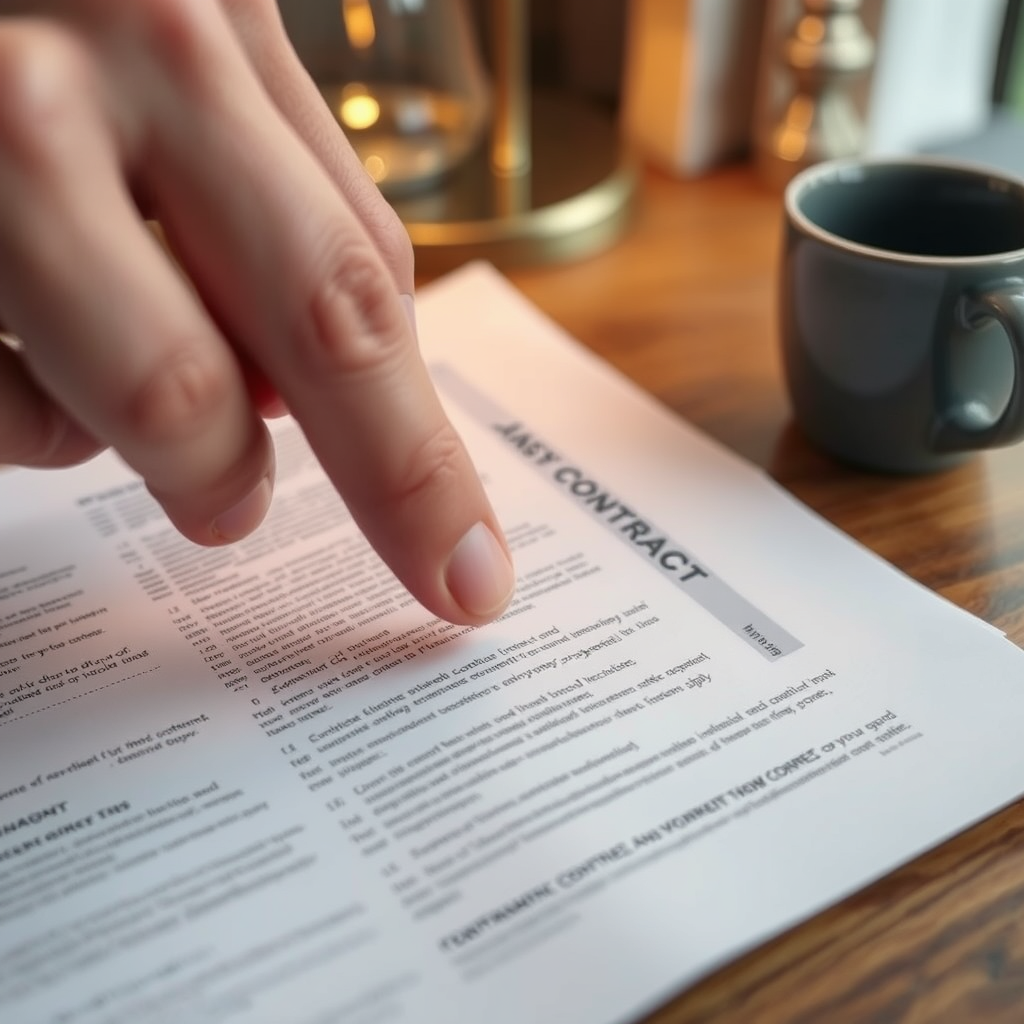
one part of a written agreement that deals with a single point
There's a clause in my rental contract about who pays for repairs.
More examples: The contract has a clause that says you can't have pets. • Lawyers spent hours arguing about one clause. • I always check the cancellation clause before I sign anything.
Common collocations: a hidden clause, read the clauses carefully, a clause about payments
Word family: clauses (plural)
Synonyms: section, paragraph, term
Antonyms: the whole document
Related concepts: contract, small print, agreement
Contexts: rental agreements, job contracts, insurance policies
Usage note: Use 'clause' for any separate section of a contract or official agreement. It's more precise than 'part' and sounds natural in work and everyday legal talk.
binding

if an agreement is binding, you must follow it
Once you sign, the contract is binding — you can't just change your mind.
More examples: A verbal agreement can even be binding in some countries. • The deal only became binding after both companies signed. • Is a promise made by email legally binding?
Common collocations: a binding agreement, legally binding, binding on both sides
Word family: bind (verb), bound (past form)
Synonyms: official, enforceable, final
Antonyms: optional, non-binding, informal
Related concepts: signature, law, commitment
Contexts: business deals, court decisions, signed contracts
Usage note: Often used with 'legally'. Use it to describe agreements, promises or decisions that you cannot ignore without consequences.
loophole

a weakness in a rule that lets you avoid it
Companies found a loophole in the tax law and paid almost nothing.
More examples: There's a loophole in the contract — it doesn't say anything about weekends. • The government closed the loophole last year. • He escaped the fine by finding a clever loophole.
Common collocations: find a loophole, close a loophole, slip through a loophole
Word family: loopholes (plural)
Synonyms: gap, escape route, weakness
Antonyms: airtight rule, closed door
Related concepts: tax law, rules, clever tricks
Contexts: taxes, contracts, sports rules
Usage note: Often suggests someone cleverly using a mistake or gap. Neutral in grammar, but can sound slightly sneaky depending on tone.
negotiate

to talk with someone to reach an agreement both sides accept
She negotiated a lower price for the apartment before signing.
More examples: You can negotiate the terms of a job offer — many people don't try. • The two countries negotiated for months. • I negotiated with the seller and got ten percent off.
Common collocations: negotiate a deal, negotiate the terms, negotiate with someone
Word family: negotiation (noun), negotiator (person), negotiable (adjective)
Synonyms: bargain, discuss terms, make a deal
Antonyms: accept without question, dictate
Related concepts: salary talks, buying and selling, diplomacy
Contexts: job offers, markets, business contracts
Usage note: Both sides give something and get something. Use it for prices, salaries, contracts and deals — not for one-sided orders.
obligation

something you must do because of a rule, law or promise
Paying rent is a legal obligation for anyone who signs a lease.
More examples: Parents have an obligation to look after their children. • I felt an obligation to help after all she'd done for me. • The company failed to meet its obligations to workers.
Common collocations: a legal obligation, feel an obligation, meet your obligations
Word family: obliged (adjective), obligatory (adjective)
Synonyms: duty, responsibility, commitment
Antonyms: choice, option, freedom
Related concepts: contracts, promises, the law
Contexts: work, family life, rental agreements
Usage note: Stronger than 'duty' in everyday talk and often connected to contracts, laws or promises. Can be legal or personal ('I felt obliged to...').
Vocabulary Check
- What does 'clause' mean?
- One part of a written agreement that deals with a single point
- The money you pay to cancel a contract
- A person who signs an agreement
- A type of lawyer who checks documents
- Which sentence uses 'binding' correctly?
- The binding of the price was too high for me.
- Once you sign, the contract is binding and you must follow it.
- She binding the document very carefully yesterday.
- A binding is a small mistake in a contract.
- In which situation would you use the word 'loophole'?
- When you want to describe a weakness in a rule that lets someone avoid it
- When you want to describe paying a bill on time
- When you want to describe greeting a lawyer politely
- When you want to describe printing a long document
- What does 'negotiate' mean?
- To sign a document as quickly as possible
- To discuss with someone in order to reach an agreement
- To break a promise you made earlier
- To copy a document word for word
- In which situation would you use the word 'obligation'?
- When you describe something you do freely for fun
- When you describe a discount you received
- When you describe a signature on a page
- When you describe something you must do because of a rule or promise
Idioms & Phrasal Verbs
be in a hurry
moving or acting fast because you don't have much time
I was in a hurry this morning, so I skipped breakfast.
Usage note: Usually with 'in': 'in a hurry'. You can also say 'in no hurry' to mean you're relaxed about it. · Right: I was in a hurry · Avoid: I was on a hurry
push back on
to resist or complain about something to try to change it
She pushed back on the extra weekend hours and her boss agreed to change them.
Usage note: The small word 'on' shows what you're resisting: push back ON a rule, a price, a deadline.
Usage note: Common at work, especially about salaries and conditions. Slightly informal but fine in meetings.
sign up for
to agree to join or start something, like a service or course
I signed up for a gym membership in January and never went again.
Usage note: Can be split: 'sign up for a plan' or 'sign up for it'. Never 'sign it up for'.
Usage note: Often used for subscriptions and free trials — perfect for talking about contracts.
the small print
the detailed rules in a contract, often written small and easy to miss
Check the small print before you accept — that's where they hide the fees.
Usage note: The picture: important conditions literally printed in tiny letters at the bottom of a page.
Usage note: British English; Americans usually say 'the fine print', which means the same thing.
Language Practice: Talking About Agreements
Practice expressing ideas about contracts, deals and duties.
- Comparing different views about contracts
- Emerging: Some people say ___, but I think ___. — Some people say contracts are boring, but I think they're important.
- Developing: Some people say ___, but I think ___ because ___. — Some people say simple contracts are better, but I think exact words matter because small changes can alter the meaning.
- Expanding: While some people argue that ___, I'd say ___, because in my experience ___. — While some people argue that plain English contracts protect everyone, I'd say they can oversimplify, because in my experience the tricky details are exactly where disputes start.
- Weighing up pros and cons of a contract or deal
- Emerging: The good thing about ___ is ___. The bad thing is ___. — The good thing about a long contract is a lower price. The bad thing is you're stuck.
- Developing: The advantage of ___ is ___, but the disadvantage is that ___. — The advantage of a binding contract is security, but the disadvantage is that you can't change your mind easily.
- Expanding: On the plus side, ___; on the other hand, ___, so it really depends on ___. — On the plus side, a binding agreement protects both sides; on the other hand, it limits your freedom, so it really depends on how much you trust the other party.
- Imagining a situation with contracts (hypothetical)
- Emerging: If I found ___, I would ___. — If I found a loophole, I would use it.
- Developing: If I ___ before signing, I would probably ___ because ___. — If I read the small print before signing, I would probably avoid surprises because that's where they hide.
- Expanding: If I were in that situation, I would ___ first, and then I'd ___ unless ___. — If I were in Maya's situation, I would check the document carefully first, and then I'd negotiate unless the company refused to talk.
Fill in the Blanks
When my brother rented his first flat, the agent told him signing was just a formality. But the paper said he had an _____ to pay the full year, even if he moved out early. Luckily, a friend checked the document and found a _____: the landlord had forgotten to sign one page, so the deal was not _____. There was also a _____ about repairs that seemed unfair, so my brother decided to _____ before signing anything. In the end, the landlord agreed to fix the heating, and everyone was happy.
Word bank: clause, binding, loophole, negotiate, obligation
Sentence Unscramble
- Read / every / clause / before / you / sign / a / contract.
- A / small / loophole / can / change / the / whole / agreement.
- She / negotiated / a / better / deal / with / the / phone / company.
Discussion Questions
Most adults sign something every year — a phone plan, a rental agreement, an insurance policy, a job contract. These papers are often long, and the small print is famous for hiding surprises. Some people read every word; others just sign and move on.
Think about the last thing you signed. Did you actually read it all? What made you sign the way you did?
There's a growing movement to write contracts in plain English: short sentences, everyday words, clear headings. Supporters say everyone deserves to understand what they're signing. Critics say legal language exists for a reason — one wrong word can change the whole meaning.
Which side are you closer to: simple language for everyone, or exact legal words even if they're hard? Why?
Imagine you've signed a one-year gym membership. A few months in, you discover a mistake in the contract — a missing date — that means you could legally stop paying. The gym never noticed the error.
Would you use that loophole and stop paying, or keep paying anyway? Where's the line between clever and unfair?
In some cultures, negotiating prices or conditions is completely normal — at markets, with landlords, even for salaries. In others, people accept the first offer because negotiating feels uncomfortable or even rude. Contracts are one place where negotiating can really pay off.
Have you ever negotiated anything — a price, a salary, a deal? How did it go, and would you try it with a contract?
Job contracts often include obligations: working certain hours, giving notice before leaving, keeping company information private. Some obligations feel reasonable; others can feel one-sided, especially for people new to a job or a country.
What obligations would you accept happily in a job contract, and what would you push back on before signing?
Knowledge Check
- What is a 'clause' in a contract?
- The date you sign the document
- The total amount of money you pay
- One part of the agreement that covers a single point
- The person who writes the contract
- True or false: a binding contract is one you can ignore whenever you want.
- True
- False
- If you find a loophole in a contract, you have found...
- a spelling mistake you must report
- a weakness that lets you avoid part of the agreement
- the most important clause in the document
- a rule you must follow very strictly
- True or false: negotiating means discussing with someone to try to reach an agreement.
- True
- False
- An 'obligation' is best described as...
- something you must do because of a rule, law or promise
- something you choose to do in your free time
- a discount offered to new customers
- a document you keep for your records
- If you "push back on" a rule at work, what do you do?
- You ignore it completely
- You resist it and try to get it changed
- You follow it without asking questions
- You write it down carefully
Free to use with your students: Free to teach, screen-share, print and share with your students, with a credit to PlanWise ESL. Please do not sell it or republish it as your own. What you can do with free lessons.