Handling Difficult Guests Like a Pro
About this lesson: This is a B1 (Intermediate) ESL lesson in the Business English category. It takes about 60 minutes. It includes 5 vocabulary words, 3 phrasal verbs and expressions, a reading text, comprehension questions, discussion questions and speaking patterns. Suits one-to-one or small-group online classes. Free to open and teach with no login, and it prints as a PDF.
Print just the discussion questions
How this lesson is built
This is a complete conversation lesson built on a scientific pedagogical formula, not a generic worksheet: recall prior topic vocabulary, pre-teach the new words in depth, read in context, practise active recall with flashcards and synonyms/antonyms, build accuracy with exercises, and finish with deep discussion.
- Warm-up: Discussion questions that connect the topic to the student’s own life and recall vocabulary they already know about the subject.
- Reading: A text written for this CEFR level that uses each new word two or three times in context, giving the student something meaningful to react to.
- Key vocabulary: 5 new words, pre-taught before the reading with a definition, pronunciation guide, example sentences and a picture, plus word families, usage notes, recall flashcards and synonyms/antonyms, giving a solid grounding before reading.
- Comprehension: 5 questions that check the new words: retrieval practice, not rereading.
- Idioms and phrasal verbs: Expressions taken from the reading, each with its meaning, an example and a speaking question.
- Sentence frames: 3 speaking patterns, each at three levels of support (emerging, developing, expanding) with model answers—especially helpful scaffolding for beginners and less confident speakers.
- Gap-fill: The new words again, in a shuffled order, so the student recalls them by meaning in context.
- Sentence unscramble: Natural sentences with the new words to put back in order, reinforcing grammar and collocation.
- Discussion: 5 open questions designed to talk deeply about the subject while actively using the lesson’s target vocabulary: the heart of a conversation lesson.
- Quiz: A short retrieval check that brings every new word back once more.
Unlike a generic worksheet, the new words are taught before the reading and met again in the activities, the speaking is supported at three levels and most of the time goes on the student talking. Teachers who use PlanWise ESL also get per-student vocabulary tracking (recycling earlier words into future readings and questions), a private learner dashboard with flashcards and custom lesson creation, and a downloadable study PDF.
Warm-up Activity
Talk about difficult customers and service jobs before reading.
- Have you ever worked in a shop, hotel, or restaurant?
- Have you ever seen a customer get angry? What happened?
- When was the last time you complained about bad service?
- Do you think service jobs are easy or difficult? Why?
- What would you say if a guest shouted at you at work?
Reading Text: A Bad Evening at the Hotel
A story about a waiter named Marco and one very difficult guest.
Marco works as a waiter in a busy city hotel. On Friday night, a guest started to complain about his food. He said the soup was cold, and his voice was loud. Other guests turned to look, so Marco felt nervous.
The man was very rude. He called the soup 'terrible' and said the hotel was the worst in the city. Marco wanted to answer angrily, but he remembered his training. He stayed calm and listened to the end.
Then Marco said, 'I'm very sorry about this. I apologize for the cold soup.' He offered a free dessert and a fresh bowl. The guest's voice became quieter, because someone finally listened to him.
Marco did not resolve everything at once. The kitchen was slow, so he waited with the guest and talked about football. Although it took ten minutes, the man smiled before the new soup arrived.
Marco's manager says a good waiter must be patient. Angry guests usually complain because they feel ignored, not because they are bad people. If you stay calm, apologize, and act fast, most problems become small. Marco agrees, and now he even teaches new staff his way.
Key Vocabulary
complain
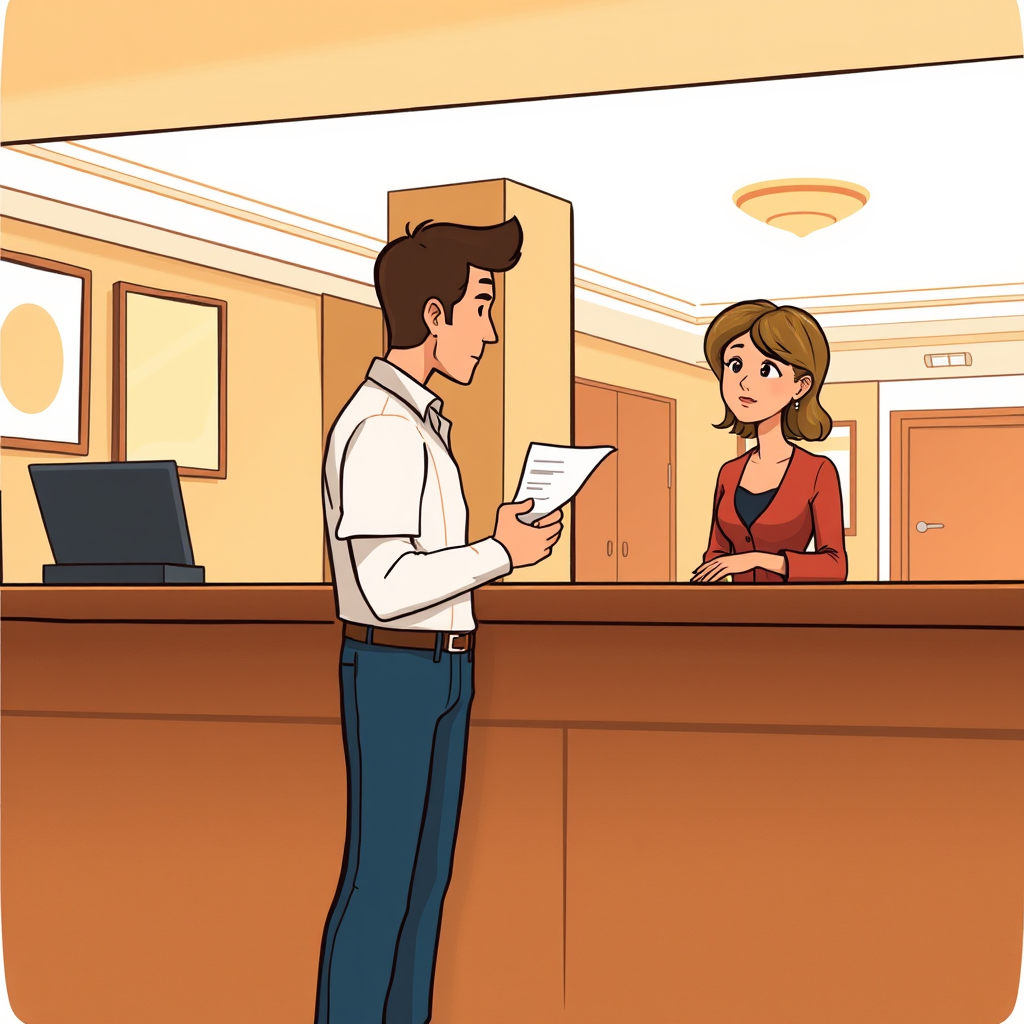
to say that you are not happy about something
The guest went to the front desk to complain about the noise.
More examples: Customers often complain when the bus is late. • She complained to the manager, politely. • I never complain about my food in restaurants.
Common collocations: complain about the service, make a complaint, complain to the manager
Word family: complaint (noun), complainer (noun)
Synonyms: object, protest, grumble
Antonyms: praise, accept
Related concepts: customer service, feedback, problems
Contexts: restaurants, hotels, airlines
Usage note: Use 'complain about' + the problem, or 'complain to' + the person. The noun is 'a complaint'.
rude
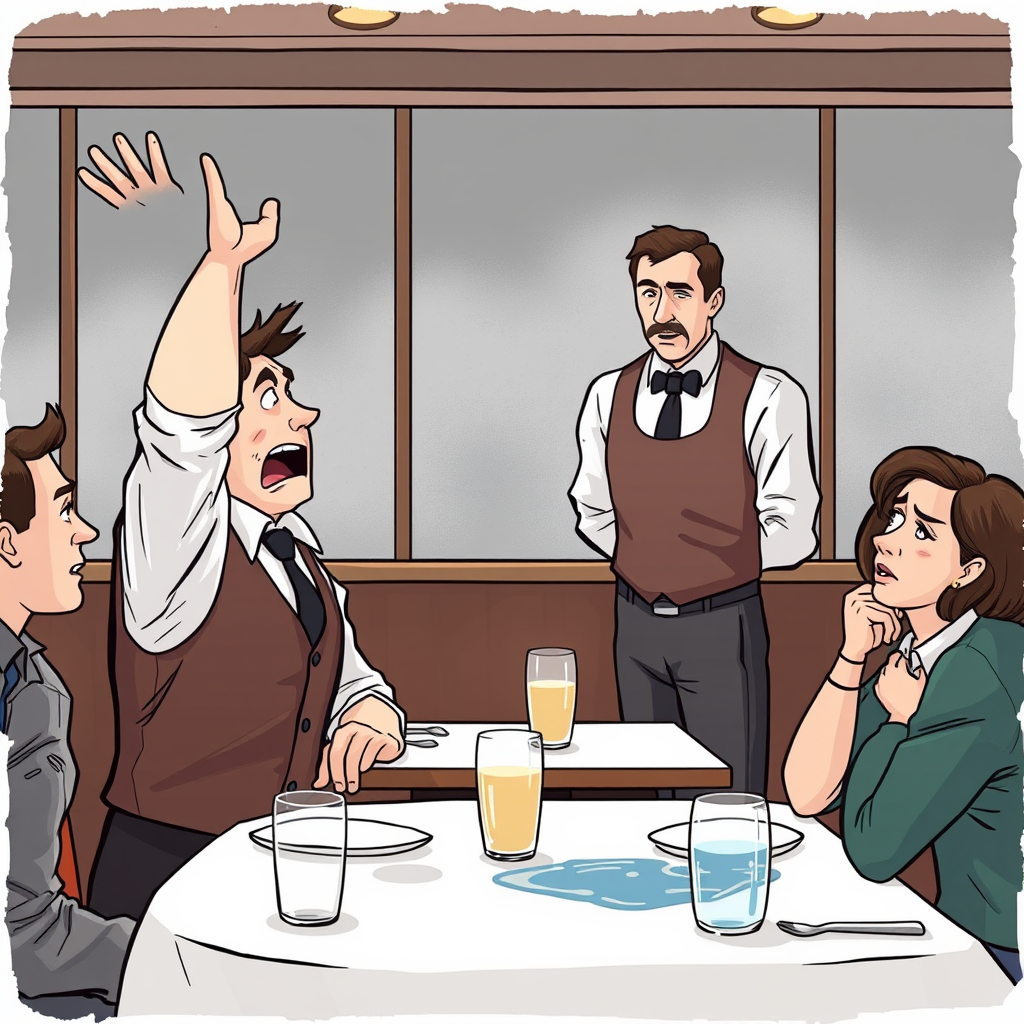
not polite; saying or doing things that hurt people
It is rude to shout at someone who is helping you.
More examples: The guest was rude to the young waitress. • Cutting in line is rude in most countries. • He answered in a rude way, but later said sorry.
Common collocations: rude to someone, a rude comment, be rude about something
Word family: rudely (adverb), rudeness (noun)
Synonyms: impolite, disrespectful, unkind
Antonyms: polite, kind
Related concepts: manners, respect, behavior
Contexts: customer service, daily life, school
Usage note: Use 'rude to + person'. Very common in everyday talk about behavior and manners.
apologize
to say sorry for something you did wrong
The manager apologized for the long wait and gave a free coffee.
More examples: I must apologize for arriving late. • She apologized to the guest and fixed the problem. • Companies often apologize publicly after a mistake.
Common collocations: apologize for the mistake, apologize to a customer, make an apology
Word family: apology (noun), apologetic (adjective)
Synonyms: say sorry, express regret
Antonyms: refuse to apologize, blame others
Related concepts: saying sorry, mistakes, customer care
Contexts: hotels, work, family
Usage note: Use 'apologize to + person' and 'apologize for + the problem'. More professional than just 'say sorry'.
resolve

to find an answer to a problem and finish it
The receptionist resolved the booking problem in five minutes.
More examples: We resolved the issue with a full refund. • Good staff resolve problems without asking the boss. • The two managers resolved their disagreement calmly.
Common collocations: resolve a problem, resolve a complaint, resolve the situation
Word family: resolution (noun), resolvable (adjective)
Synonyms: solve, fix, settle
Antonyms: create, worsen
Related concepts: problems, solutions, negotiation
Contexts: work, customer service, family arguments
Usage note: Common in work talk. Sounds professional but is standard B1. 'Solve' is a close everyday synonym.
patient

able to wait or stay calm without getting angry
A good waiter stays patient with slow or angry guests.
More examples: Be patient, the food is coming in five minutes. • She is patient with children, so she loves teaching. • He lost patience and left the shop.
Common collocations: stay patient, be patient with someone, lose patience
Word family: patience (noun), patiently (adverb)
Synonyms: calm, tolerant, understanding
Antonyms: impatient, angry
Related concepts: waiting, self-control, emotions
Contexts: work, teaching, healthcare
Usage note: Also a noun for a sick person in hospital, but here it means staying calm. Watch the student does not confuse the two.
Vocabulary Check
- What does 'resolve' mean?
- To say sorry
- To find an answer to a problem
- To shout at someone
- To give money back
- Which sentence uses 'apologize' correctly?
- She apologized the soup.
- She apologized about to the guest.
- She apologized to the guest for the wait.
- She apologized for the guest.
- If a person is 'rude', what are they like?
- Not polite
- Very quiet
- Very tired
- Always happy
- What does 'patient' mean?
- Feeling sick in hospital
- Able to stay calm and wait
- Angry and loud
- Ready very fast
- In which situation would you 'complain'?
- When your meal arrives cold
- When you get a gift
- When you finish work
- When you meet a friend
Phrasal Verbs & Expressions
stay calm
keep your body and voice relaxed, not angry
The customer was shouting, but the waiter stayed calm.
Usage note: We usually say 'stay calm', not 'stay calmly'. 'Calm' describes the state, not the action. · Right: stay calm · Avoid: stay calmly
Usage note: Very useful at work when someone is angry or upset.
take (time)
need a certain amount of time
Sorry I'm late — the bus took an hour.
Usage note: The pattern is 'it takes + time': It took ten minutes. It takes 20 minutes to get to work. · Right: It took ten minutes. · Avoid: It was taken ten minutes.
Usage note: You can ask about time with 'How long does it take...?'
act fast
do something quickly, without waiting
When the order was wrong, the manager acted fast and fixed it.
Usage note: Past form: 'acted fast'. You can also say 'act quickly' — same meaning.
Language Practice: Service Situations
Practice talking about problems, feelings, and staying calm at work.
- Complaining politely and apologizing
- Emerging: Excuse me, I want to complain about ___. — Excuse me, I want to complain about the cold soup.
- Developing: I'm sorry to say this, but the ___ was ___, so I'd like to ___. — I'm sorry to say this, but the soup was cold, so I'd like a new one.
- Expanding: Although I know you are busy, I have to complain about ___, because ___. I hope you can ___. — Although I know you are busy, I have to complain about the wait, because my guests are getting tired. I hope you can speed it up.
- Describing how you handle angry people
- Emerging: When a guest is angry, I ___. — When a guest is angry, I listen.
- Developing: When a guest is angry, I stay ___ and I ___. — When a guest is angry, I stay calm and I listen first.
- Expanding: When a guest is angry, I stay patient and listen first, because usually ___. Then I ___. — When a guest is angry, I stay patient and listen first, because usually they just want someone to hear them. Then I apologize and offer a fix.
- Giving opinions about service and behavior
- Emerging: I think ___ is ___ because ___. — I think rude guests are bad because everyone hears them.
- Developing: In my opinion, staff should ___ when guests ___, because ___. — In my opinion, staff should stay calm when guests shout, because shouting back makes it worse.
- Expanding: I think the customer is not always right, because ___. However, staff should always ___, since ___. — I think the customer is not always right, because some guests just want free things. However, staff should always listen, since feeling heard calms people down.
Fill in the Blanks
Last summer, I worked in a seaside restaurant. One evening, a guest began to _____ loudly about his fish. He was very _____ to our young waitress, who almost cried. I remembered to stay _____, so I took him a new plate. I _____d for the mistake and offered a free drink. In the end, we _____d the problem, and he even left a good tip.
Word bank: complain, rude, patient, apologize, resolve
Sentence Unscramble
- the / guest / started / to / complain / about / the / cold / soup
- please / be / patient / with / the / new / waiters
- a / good / manager / can / resolve / most / complaints / quickly
Discussion Questions
Imagine you are eating in a nice restaurant and your main dish arrives cold. You paid a lot of money for it. The waiter looks nervous, and your friends are watching you. What you do next shows your style.
Would you complain right away, or eat it and say nothing? Why?
Some people say rude guests should be asked to leave. Others say staff must stay patient with everyone, even when guests shout. Hotels train their staff to stay calm no matter what happens.
Should staff stay patient with rude guests, or can they answer rudely back? Why?
A guest shouts at a young waiter because his order is late. The waiter is close to tears. The manager can apologize and give a free dessert, or she can defend her waiter firmly.
If you were the manager, what would you do? Why?
Now think about the other side: you are the customer. Maybe a hotel lost your booking, or a delivery arrived late. How a company says sorry can change your opinion completely.
Tell me about a time a company or restaurant made a mistake with you. Did they apologize well?
Some people get angry very fast; others stay patient for hours. Some say patience can be learned, like a muscle at the gym. Others say it is just part of your character.
Are you a patient person? What makes you lose patience quickly?
Knowledge Check
- Which word means 'to say sorry for something you did wrong'?
- Complain
- Resolve
- Apologize
- Patient
- True or false: 'rude' means polite and kind.
- True
- False
- Complete the sentence: 'The manager ___ the problem with a full refund.'
- apologized
- resolved
- complained
- patient
- Which phrase is correct?
- complain to the manager
- complain the manager
- complain for the manager
- complain at the manager
- True or false: 'Please be patient' means 'please wait calmly without getting angry'.
- True
- False
- Your friend says: 'Stay calm — it's not a big problem.' What does she want you to do?
- Shout louder
- Relax and don't get angry
- Leave quickly
- Ask for money
Free to use with your students: Free to teach, screen-share, print and share with your students, with a credit to PlanWise ESL. Please do not sell it or republish it as your own. What you can do with free lessons.